
Responsible investment
We are a responsible investor
Zurich is proud to be a leading responsible investor. We believe creating long-term, sustainable value - doing well and doing good - is not only possible, but necessary. When we do ‘well’, we generate superior risk-adjusted returns for our customers and shareholders. When we do ‘good', we have a positive impact on society and the communities where we live and work. Whether it’s helping reduce CO2e emissions or helping people improve their lives, our in-house and external experts focus on improving the financial performance, transparency and positive impact of our portfolio.
Since we manage more than USD 170 billion of own assets, by doing well and doing good, we can achieve substantial, long-term outcomes that benefit both people and the planet. We focus on three distinct outcomes: fulfilling our commitment to transitioning our investment portfolio to net-zero by 2050, as well as helping avoid 5 million metric tons of CO2e emissions and benefiting 5 million people per year through our impact investments. In 2024, Investment Management successfully met its 2025 interim climate targets and impact investing targets. These milestones mark a significant step in Zurich’s journey toward net-zero and we continue progressing towards our 2030 interim climate targets.
Our approach to sustainability strives to create value for both our company and for society as a whole
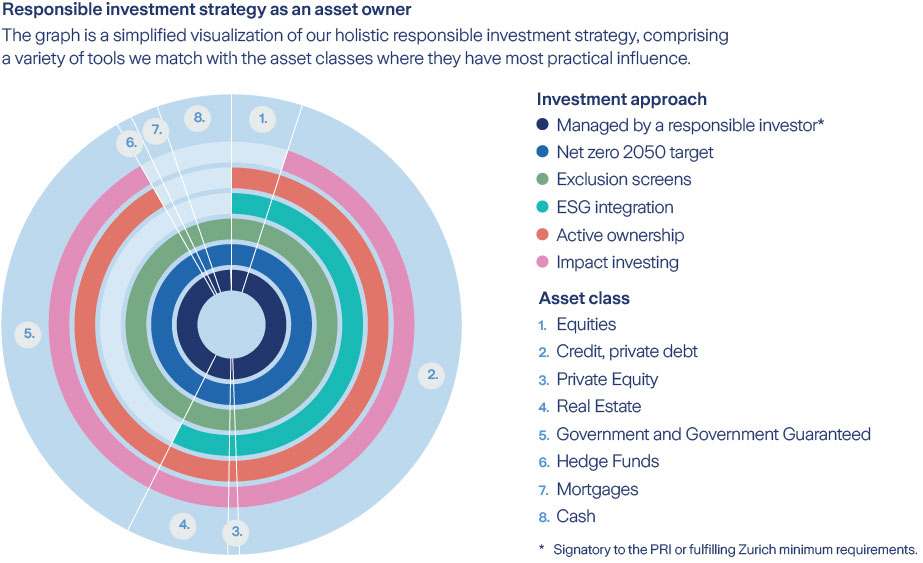
Zurich is a signatory to the United Nations-backed Principles for Responsible Investment (PRI) and the Operating Principles for Impact Management. Our comprehensive responsible investment strategy covers the entirety of our proprietary assets, matching a variety of responsible investment tools with the asset classes where they have most practical influence, and is also applicable to many of our unit-linked offerings.
Almost all our own assets are managed by a PRI signatory or asset manager that fulfills our minimum requirements for responsible investment. This ensures that also our externally managed assets are handled according to our values.
Total asset base of balance sheet assets of approximately USD 170 billion of own assets
Insurance investment management is relatively complex. Everything starts with the business footprint of our insurance activities. Whether we sell car insurance in Italy, life insurance in Japan, insure buildings in Chile, or protect companies against natural catastrophes in Australia – the type and geography of our business determine where we will have to invest the resulting premiums, and how long we need to look after the money before claims might need to be paid. To effectively manage investment risks relative to those insurance liabilities, Zurich has a very strong focus on Asset-Liability Management (ALM). The first step in this process establishes a portfolio of investments that closely replicates our insurance liabilities and consists primarily of duration-matched government bonds.
Insurers are required, by the financial regulator, to hold certain assets. For instance, Zurich must back certain local currency liabilities by holding corresponding sovereign bonds. We must also take into account tax considerations, requirements to balance investment income and total return, as well as other constraints that vary widely across local jurisdictions.
As a result, investment choices can be restricted in some asset classes, such as sovereign bonds.
It is also worth noting that only around 5 percent of Zurich’s assets is held in cash. At any given point in time, most of our investment portfolio is invested, often for many years, and hence not available for new investments. This long-term view allows us to be a strategic and reliable investor in long-termed asset classes such as real estate, infrastructure or private equity.
Zurich holds investments in over 800 different portfolios, on over 200 different balance sheets in over 40 jurisdictions, managed by over 40 different external, as well as internal, asset managers. This complexity naturally limits the ability to apply specific processes and approaches in every single instance. Due to the complex reality of insurance asset management, we match the responsible investment tools at our disposal with the asset classes where they have most practical influence on value creation, risk management and positive outcomes.
If you want to learn more about how investment management creates value for the overall business, read the value creation paper.
Asset class breakdown
Guided by our ALM strategy, we apply our responsible investment principles on an asset class level.
| Credit |
|
| Supranational, Government and Government Guaranteed Bonds |
|
| Private debt |
|
| Listed equities |
|
| Private Equity |
|
| Real Estate |
|
| Mortgages |
|
| Hedge Funds |
|
| Cash & Short Term |
|
Our responsible investment strategy
Responsible investment means different things to different people. There are a number of approaches and tools for responsible investment.
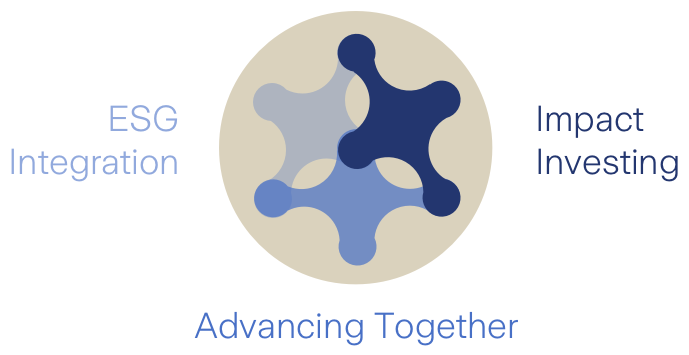
Zurich’s strategy comprises three core elements while consistently integrating climate action, and following a group-wide approach on exclusions:

ESG Integration
- Training
- Information
- Process Integration
- Active Ownership Integrating environmental, social and governance factors

Impact Investing
- Intentionality
- Measurability
- Profitability Making an impact by funding solutions

Advancing together
- Innovation
- Collaboration
- Public advocacy Collaborating to advance responsible investment
Climate Action
- Our journey to net-zero
Exclusions
- Read more about our group-wide exclusion policies
Awards
We are grateful and proud that our responsible investment approach has been honored with several awards.

2026
1. Place: “Re/insurer of the Year” Environmental Finance Sustainable Investment Awards 2026
2026
1. Place: “Investor of the Year (asset owner)” Environmental Finance Sustainable Debt Awards 2026
2026
1. Place: “Responsible Investor of the Year – re/insurer” Insurance Asset Risk’s UK & Europe Awards 2026
2025
1. Place “Responsible Investor of the Year – re/insurer” Environmental Finance IMPACT Awards 2025
2025
1. Place “Responsible Investor of the Year – re/insurer” Environmental Finance Sustainable Debt Awards 2025
2025
1. Place: “Responsible investor of the Year - re/insurer” Insurance Asset Risk’s UK & Europe Awards 2025
2024
1. Place: “Responsible investor of the Year - re/insurer” Environmental Finance IMPACT Awards 2024

2024
1. Place: “Responsible Investor of the Year - Insurer” Insurance Asset Risk Insurance Asset Risk Awards 2024 - UK & Europe
2023
Place: “Re/insurer of the Year” Environmental Finance Sustainable Investment Awards 2023
2022
Place: “Re/insurer of the Year” Environmental Finance Sustainable Investment Awards 2022
2020
Place: “Best Impact Report of the Year (for investors)” Environmental Finance Bond Awards
2019
Place: “Impact Asset Owner of the Year” Global Steering Group for Impact Investing (GSG)
2019
Place: “Most Impressive Green/SRI investment professional ” Global Capital Responsible and Sustainable Investment Awards
2018
Global Capital Responsible and Sustainable Investment Awards
3. Place: : “Most impressive Green/SRI investment firm”
3. Place: : “Most impressive Green/SRI investment professional”
2017
Global Capital Responsible and Sustainable Investment Awards
3. Place: : “Most impressive Green/SRI investment firm”
1. and 2. Place: “Most Impressive Green/SRI investment professional”
2016
1. Place: “Best ESG program in the DACH region” Institutional Investor Institute Peer-to-Peer Awards
2015
1. Place: “Best ESG program of Italian asset owner” Forum per la Finanza Sostenibili Awards