The AI resilience challenge
DigitalReportNovember 23, 2026
How an insurance lens can help keep AI-related risks manageable.
Artificial intelligence is becoming part of everyday operations of businesses, governments and society. It can improve productivity, services and decision-making. But as AI is used in more important areas, failures may have consequences far beyond the system or organization where they begin.
Many of the risks associated with AI are already familiar, from cyber incidents and fraud to liability and business interruption. What can change is their scale and reach. As AI becomes more widely used, a problem in one system or organization can have consequences elsewhere. Drawing on insights from 50 experts, this report from Zurich and the University of St. Gallen explores how these connections arise and how businesses, insurers and policymakers can strengthen resilience.
How AI-related risks connect
The report identifies two ways in which problems linked to AI can have wider consequences.
Concentration of risk arises when many organizations rely on the same provider, model, infrastructure or component. If that shared technology is disrupted, many organizations may be affected at the same time.
Managing this risk starts with understanding these shared dependencies. Organizations also need reliable alternatives and plans to keep essential operations running if a provider or system becomes unavailable.
Correlation of risk can arise even when organizations use different providers. Separate AI systems may behave or fail in similar ways because they rely on similar data, models, assumptions or safeguards. This risk can be harder to identify because there may be no single provider or system at the center of the problem. Organizations need to test how their systems behave under different conditions, question common assumptions and maintain meaningful human oversight.
Together, concentration and correlation can turn a problem affecting one organization into wider disruption.
Mapping risks to guide action
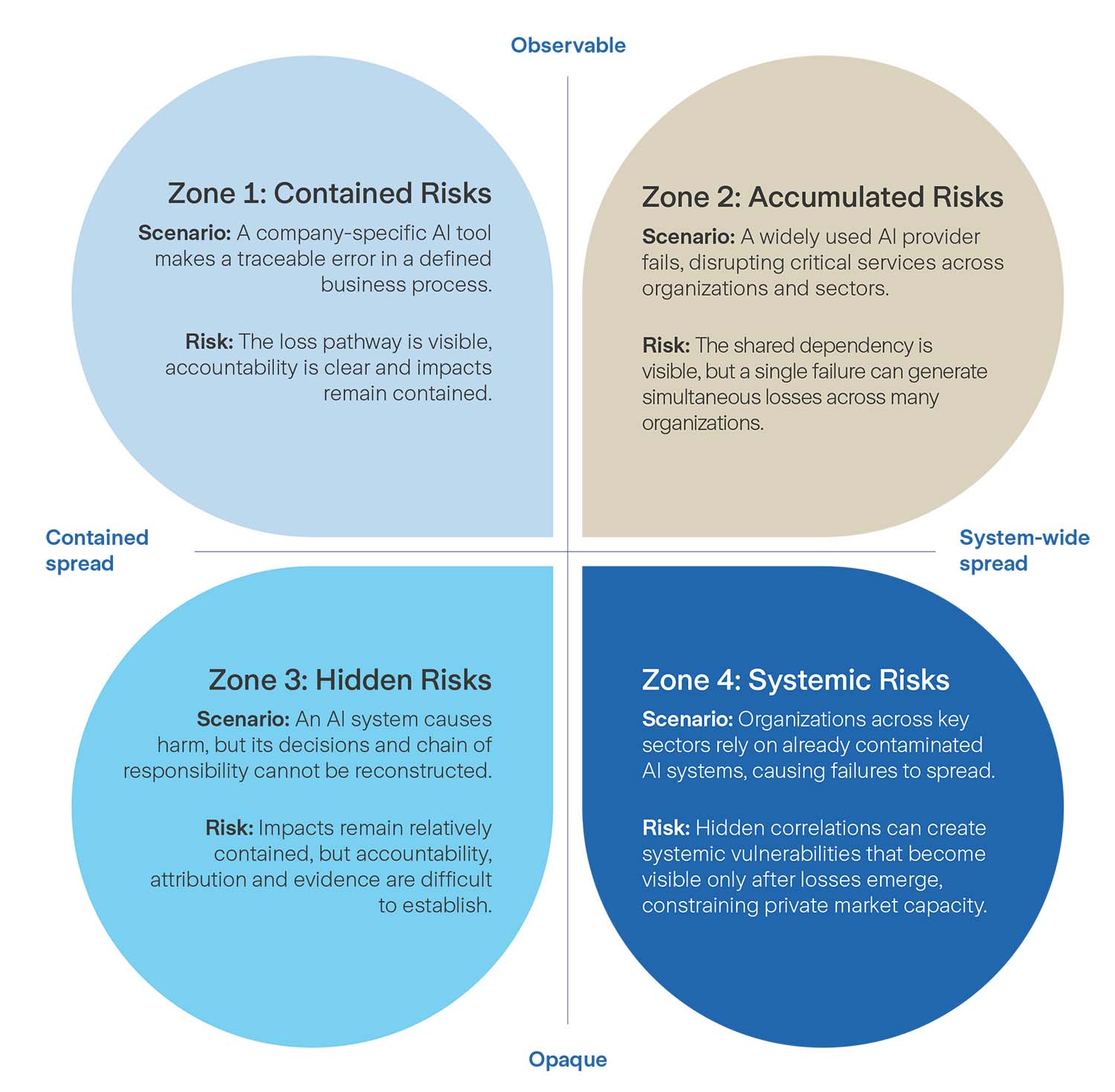
Not every AI-related risk requires the same response. The report introduces a four-zone map based on two questions: How well is the risk understood, and how widely could its impact spread?- Refine: Strengthen existing safeguards and insurance approaches for risks that are understood and contained.
- Manage: Reduce the potential impact of shared dependencies or systems that may behave in similar ways.
- Build: Develop the knowledge, responsibilities and safeguards needed for risks that are not yet well understood.
- Coordinate: Bring together businesses, insurers and public authorities when risks could spread widely or become too large for any one organization or sector to manage alone.
But these zones are not fixed. Risks related to AI can move from one zone to another. Wider use of AI and greater reliance on a small number of technologies can increase its potential impact. The report suggests how better information, stronger safeguards and tested recovery plans can make the same risk more manageable.
Turning the framework into action
Organizations and technology providers need a clear picture of how they use AI and which providers and systems they rely on. They need to define responsibilities, test what happens when systems fail or behave unexpectedly, and ensure that important systems can be overridden, replaced or safely shut down.
Insurers need to understand how common providers, models and patterns of behavior could affect many customers at once. Better information about incidents and realistic scenario testing can show where risks are building and where insurance may become more difficult to provide. Policymakers can improve transparency, clarify responsibilities and support consistent incident reporting and testing. When risks cross sectors or borders, cooperation between businesses, technology providers, insurers and public authorities will be essential.
The aim is not to prevent every AI failure. From an insurance and risk management perspective, our goal is to detect failures early, contain their impact and recover quickly, to keep losses within society’s capacity to absorb them.