Why construction must build resilience before breaking ground
In the construction industry, climate extremes, labor shortages, impatient capital and rising cyber threats are no longer isolated risks – they are converging, reshaping what can be built, how fast and on what terms.
A new report from Zurich Insurance Group (Zurich), Beyond 2030: The Future of Construction, uses insights from 31 industry experts to map how these pressures interact and why the window to act is at the design stage, not on the construction site.

Our customers deliver more complex projects in an increasingly volatile risk environment, all under more compressed schedules. Our latest research makes clear that if a project is not insurable, it will not be financed. Therefore, building resilience into the design, with insurers at the table early, is critical to making projects viable.
Kelly Kinzer, Global Head of Construction & Surety
A sector under pressure: risks converging, costs rising
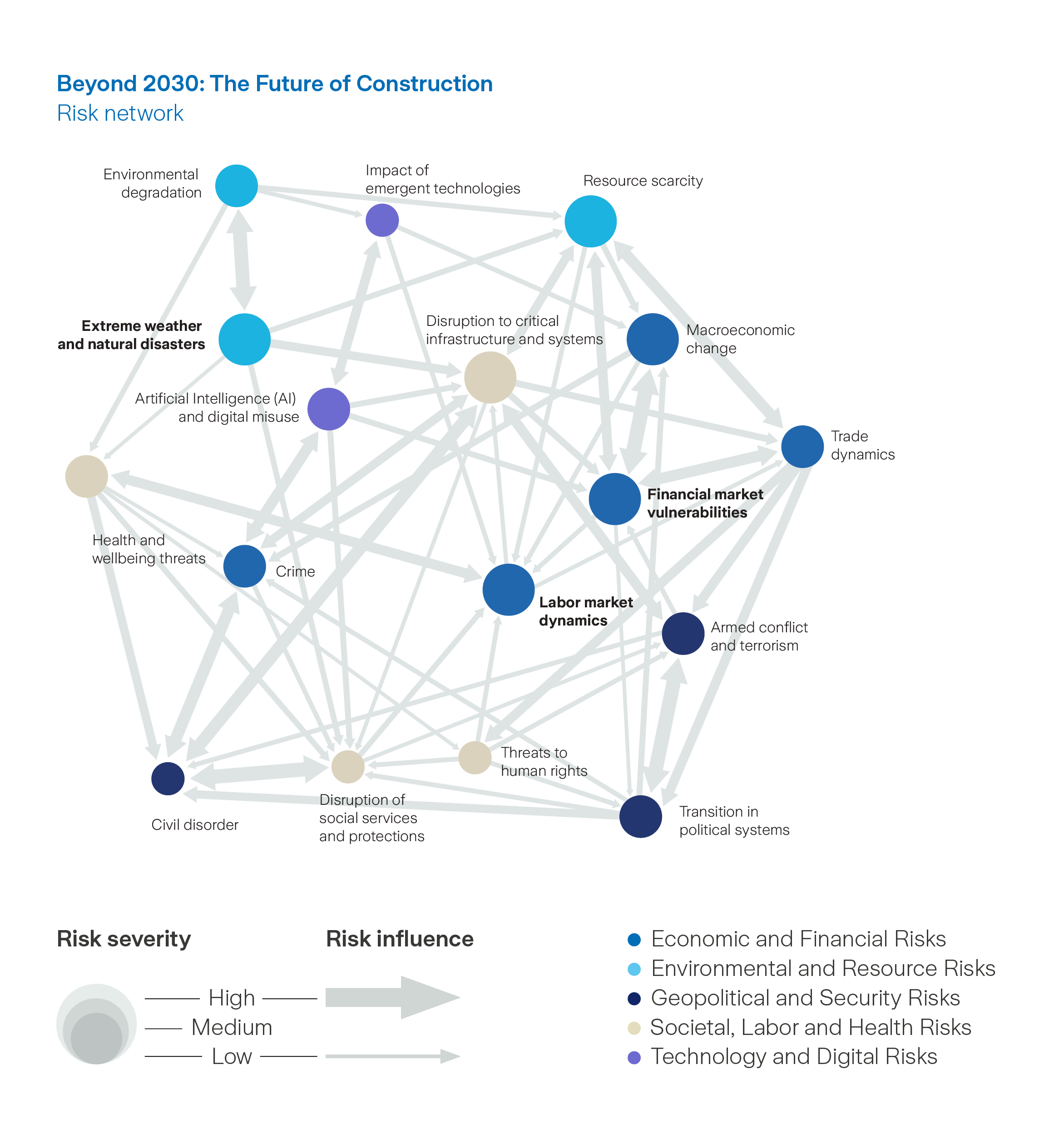
Extreme weather and natural disasters rank as the most severe risk to the construction sector over the next five years, scoring 6.2 out of 7 on the report's risk severity scale, with financial market vulnerabilities (5.7) and labor market dynamics (5.6) close behind.
These risks are not independent. Disruption to critical infrastructure sits at the center of the risk network. It is the single most connected risk, most likely to be triggered by other pressures and to amplify them in turn.
Labor constraints illustrate the depth of the challenge. The U.S. construction sector alone needs an estimated 349,000 additional workers this year to keep up with project demand. Southeast Asia faces a shortfall of 1.5 million skilled workers, while Australia expects a gap of more than 300,000 by 2027.
At the same time, capability, not just headcount, is becoming the binding constraint, as experienced workers retire and technical complexity increases.
In the UK, the training pipeline for key trades like engineering, manufacturing or plumbing and heating, is so stretched that more than 100 vacancies exist for every apprenticeship place. In the US, the problem compounds over time: around two in five construction workers employed in 2020 are expected to retire by 2031, taking with them experience that has no simple replacement.
Digital risk is rising just as fast. Nearly four in five architecture, engineering and construction companies have experienced a cybersecurity threat in the past two years, with an average of 226 incidents per company per year, a 41 percent year-on-year increase.
Only one percent of global losses from cyber incidents is insured, leaving most of the financial impact with contractors and project owners directly.
Large capital projects continue to run about 80% over budget and more than 50% behind schedule. The average data center project now carries a value of USD 3 billion, up from USD 150 million just five years ago driven by the rapid expansion of Artificial Intelligence, reflecting a concentration of risk that is pushing the limits of both delivery models and insurance capacity.
Insurability is becoming a leading indicator of viability
The report highlights a critical shift: Insurability is emerging as a leading indicator of project viability and, increasingly, a real-time signal of underlying resilience. As financing structures tighten and room for errors shrinks, risk is moving upstream into feasibility, siting and procurement decisions made long before construction begins. Insurance plays a central role in this shift. Where coverage is unavailable, restricted or unaffordable, lenders may revise terms, delay or reduce funding altogether, making insurability a clear early signal of whether a project is viable at scale.
The report argues that insurance terms highlight underlying delivery risks earlier than capital markets and urges project owners and contractors to treat insurability as a leading indicator alongside cost, schedule and safety, not as an afterthought once construction is underway.
About the research
Beyond 2030: The Future of Construction draws on structured insights from 31 experts across underwriting, claims, risk engineering and construction, gathered through interviews conducted between December 2025 and March 2026. The research integrates survey input assessing the severity of 17 risks to the construction sector on a seven-point scale and their interconnections. The analysis prioritizes the quality and diversity of expertise over volume of input, focusing on the most consequential pressures shaping construction decisions with the aim of building resilience in the years ahead.
Further Information
The full report Beyond 2030: The Future of Construction can be found here.
Downloads
Contacts
- Media Relations
- Investor Relations
Zurich Insurance Group (Zurich) is a leading global multi-line insurer founded more than 150 years ago, which has grown into a business serving more than 82 million customers in more than 200 countries and territories, while delivering industry-leading total shareholder returns.
Reflecting its purpose to ‘create a brighter future together,’ Zurich offers protection services that go beyond traditional insurance, to support its customers in building resilience. Since 2020, the Zurich Forest project has been supporting reforestation and biodiversity restoration in Brazil’s Atlantic Forest.
The Group has more than 65,000 employees and is headquartered in Zurich, Switzerland. Zurich Insurance Group Ltd (ZURN) is listed on the SIX Swiss Exchange and has a level I American Depositary Receipt (ZURVY) program, which is traded over-the-counter on OTCQX. Further information is available at www.zurich.com.