
From boardroom priority to capability: Introducing the Personal Resilience Index
ArticleJune 30, 2026
The real value of resilience lies in how organisations measure and strengthen their capacity to adapt and sustain wellbeing.
Resilience has become one of the defining themes of modern organisational leadership. Yet for many employers, it remains an elusive concept, recognised as essential but rarely measured in ways that inform strategic decisions.
In a previous Zurich perspective, Alison Martin argued that personal resilience belongs in the boardroom. As disruption becomes continuous rather than episodic, organisational success increasingly depends on the adaptive capacity of people — their ability to sustain wellbeing, maintain performance, and recover from disruption.
Today, resilience is moving beyond the language of wellbeing into the language of risk, performance, and long-term sustainability. The Personal Resilience Index (PRI) was developed to address that challenge.
Rethinking resilience for a changing risk landscape
Resilience is often framed as an individual trait — a quality that some people naturally possess. However, personal resilience is best seen as a dynamic process: the capacity and demonstrated ability to sustain, restore, and enhance wellbeing in the face of ongoing challenges.
Rather than focusing solely on mindset or coping behaviours, this recognises resilience as emerging from a broader system of resources and conditions. Psychological outlook matters, but so do financial stability, physical health, social support networks, and digital capability.
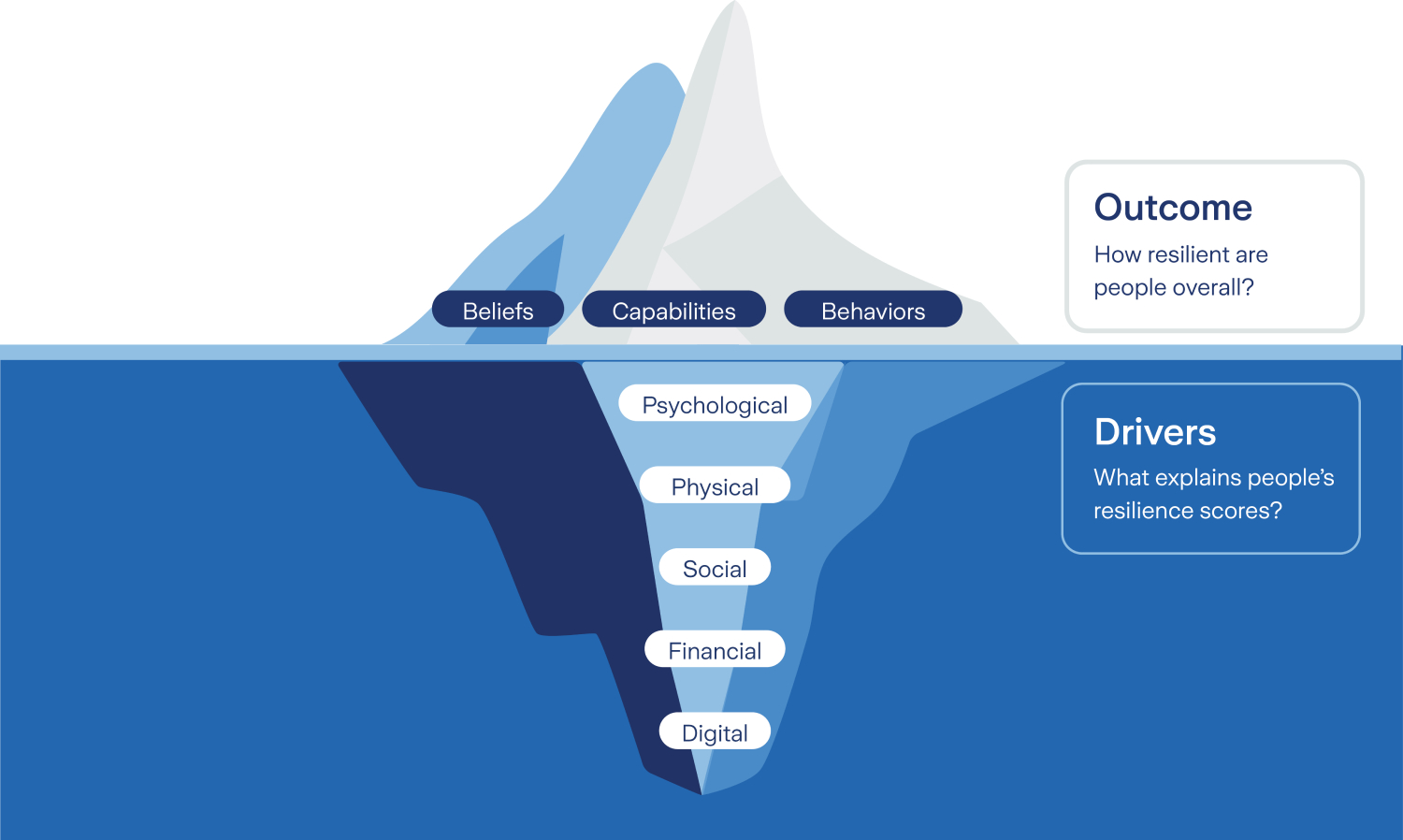
Equally important is distinguishing between resilience itself and the factors that shape it. Many existing approaches blur these concepts, measuring general wellbeing without clarifying underlying drivers. The PRI intentionally separates resilience as an outcome from the drivers that explain it — a distinction that allows measurement to support decision-making rather than simply describe experience.
Why measurement changes the strategic conversation
Organisations already collect extensive data on employee experience, engagement, and health. Yet most measures capture only a snapshot in time — how employees feel today. Resilience introduces a different lens. It focuses on adaptive capacity: the ability to maintain stability and recover when conditions shift.
For HR and Risk leaders, this reframes resilience as a leading indicator rather than a lagging outcome. Measuring resilience helps organisations anticipate where challenges may emerge and strengthen protective factors before disruption translates into operational or financial risk.
Resilience is a measurable capability that shapes how people and organisations respond to continuous change while sustaining wellbeing.

The architecture of the Personal Resilience Index
The PRI translates this understanding into a structured measurement framework grounded in interdisciplinary research and validated through a two-stage empirical development process.
Its architecture reflects a key insight: resilience must be understood both as a holistic outcome and as the product of interacting life domains.
At the centre sits the Personal Resilience Index itself, which summarises overall adaptive functioning. Surrounding it are five empirically validated domains — psychological, physical, financial, social, and digital — that function as drivers shaping resilience outcomes.
It allows organisations to distinguish between:
- how resilient individuals or populations are overall, and
- what is actively supporting or constraining that resilience.
The framework integrates enduring traits, developable capacities, and dynamic adaptive processes into a single model.
Moving beyond traditional wellbeing metrics
Traditional wellbeing measures provide valuable information about current conditions, but they often fail to reveal underlying vulnerabilities. A workforce may appear stable today while facing pressures that limit its ability to absorb future shocks.
Rather than producing a single abstract score, it highlights patterns that guide action. Organisations can identify:
- domains that actively sustain resilience,
- hidden constraints that may not yet surface in wellbeing indicators, and
- priority areas where targeted interventions are likely to yield meaningful impact.
Resilience is systemic, shaped by financial, social, organisational, and psychological factors that together influence individuals’ capacity to adapt.
Strategic implications for HR and Risk leaders
For HR and Benefits professionals, the PRI offers a way to align wellbeing strategy more closely with organisational outcomes. By understanding resilience drivers, leaders can prioritise interventions that address root causes and build long-term capacity.
For Risk Managers, the framework introduces a structured way to assess human resilience within broader enterprise risk considerations. Development research shows that the combined life domains explain a substantial proportion of variation in resilience outcomes.
At scale, the PRI supports analysis beyond the individual level. Organisations can benchmark resilience across teams or regions, identify differential vulnerabilities among workforce segments, and monitor how resilience evolves over time — transforming resilience from a qualitative aspiration into a measurable strategic indicator.
From protection to proactive resilience
The development of the Personal Resilience Index reflects a broader evolution in how organisations and insurers think about risk. Historically, much attention has focused on responding after events occur. Increasingly, however, the greatest value lies in strengthening adaptive capacity before disruption escalates.
Resilience cannot remove uncertainty. But it determines whether individuals and organisations experience disruption as decline or as adaptation. As complexity defines the modern workplace, the ability to understand and strengthen personal resilience may prove one of the most important strategic investments organisations can make.
Advancing the global understanding of personal resilience
Building on this foundation, we are now taking the next step in advancing the understanding of personal resilience at scale.
The Personal Resilience Index is now being deployed as part of a global research study examining personal resilience across populations and contexts. Spanning 16 countries, this initiative extends beyond measurement alone. It aims to generate deeper insight into how resilience varies between individuals, how it is shaped by different life domains, and how these patterns evolve across industries, geographies, and workforce segments.
Over time, the findings from this research will support more targeted and evidence-based approaches to strengthening resilience — both within organisations and at a broader societal level.
In this sense, the PRI is not only a measurement framework, but also a platform for ongoing learning. As data accumulates and insights deepen, it will help shape a more informed and proactive approach to resilience — one that reflects the complexity of modern life and supports individuals and organisations in navigating it more effectively.