Mass timber: Insuring the future of sustainable construction
Climate resilienceArticleFebruary 24, 2026
Mass timber is emerging as a powerful driver of sustainable construction. But what is it, and how is Zurich North America helping accelerate its adoption while supporting customers on their netzero journeys?
In Bentonville, Arkansas, retail giant Walmart opened its new Home Office campus in January 2025. The 350-acre (142 ha) site includes an auditorium and conference center, childcare facilities, a food hall, shops, parking decks and a substantial health and fitness complex. But what truly sets it apart is that the 12 office buildings are constructed from mass timber – making it what is believed to be the largest mass timber campus project in the U.S.
It marks the continuation of a construction revolution that is seeing major companies, including Google, Microsoft and Under Armour, adopt mass timber for new campus developments. Why? Mass timber is an engineered wood material known for both its aesthetic beauty and a smaller carbon footprint than many other more conventional materials. Mass timber buildings are not just becoming more common but also bigger and taller, too. The 25-story Ascent residential tower, rising 87 meters (284 feet) above the Milwaukee skyline, is currently the world’s tallest timber building – a record it may not hold for long.
This shift could be significant for the planet. The building industry is one of the largest contributors to carbon emissions that many associate with climate change; estimated to be responsible for around 37 percent of global energy‑related carbon emissions. Roughly 27 percent comes from heating, cooling and day‑to‑day operations, while about 10 percent is tied to construction – especially the use of steel and concrete, whose production is traditionally carbon‑intensive. By contrast, building with timber can reduce the carbon footprint of a large structure by up to 40 percent, provided the wood is sustainably sourced.
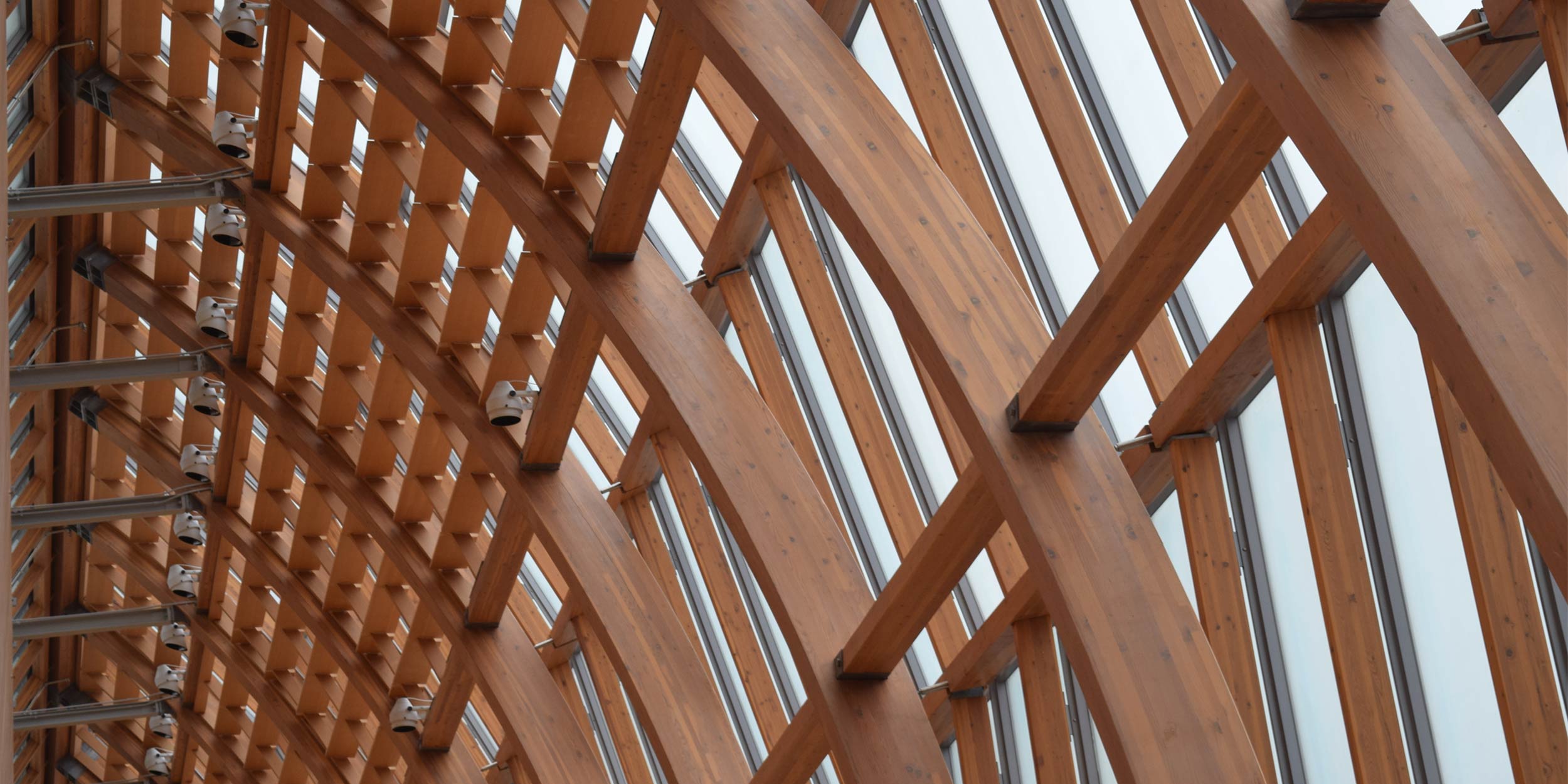
Mass timber can be used in structures such as panels and beams and is made by layering, fastening or gluing pieces of wood together at high pressure to create strong, stable components. The advent of cross‑laminated timber – formed by stacking layers of wood at right angles – gives mass timber the strength and rigidity needed for even tall, multistory buildings.
“Mass timber is a very strong, durable, versatile and, importantly, sustainable construction material,” explains Patrick McBride, Head of Construction Property at Zurich North America. “With cross-laminated timber you have the load-bearing capabilities that allow it to substitute for steel and concrete in many structural applications, including beams and columns; floor, roof and wall panels; and much more.
“It’s changing the game in the execution of commercial projects,” he adds, “and is rapidly becoming the building material of choice for a growing number of bold and ambitious commercial developments in the U.S. and around the world. We’re even seeing it in large data center projects.”
Timber’s renewed reputation
In the 19th and 20th centuries, concerns about combustibility led to timber being largely displaced by steel and concrete as primary construction materials. Interest returned with the development of cross‑laminated timber in Austria and Germany in the early 1990s, gaining momentum during the 2000s as the green building movement accelerated. Yet skepticism about its fire resistance persisted among building code regulators and insurers.
But McBride says that mass timber behaves very differently from traditional light wood‑frame structures in terms of fire risk. “Testing has found that the size and dense structure of mass timber can provide inherent fire‑resistant properties when properly designed,” he explains.
When exposed to fire, the outer surface of mass timber forms a char layer that helps insulate the inner core and protects its structural integrity. “This protective char forms at predictable rates,” adds McBride. “This allows mass timber buildings to be designed to achieve the desired fire resistance ratings required by building codes. However, the methods and feasibility of repairing mass timber after a fire is something the industry is still grappling with.”
Beyond fire testing, Zurich North America has also observed earthquake simulations. Weighing roughly one‑fifth as much as a comparable concrete structure, mass timber offers a high strength‑to‑weight ratio, enabling strong seismic performance while reducing foundation requirements.
Mass timber’s official status
A major milestone came in 2021 with the inclusion of tall mass timber structures in the International Building Code. This allows for mass timber towers up to 18 stories in the U.S., provided they incorporate specific “encapsulation” measures – such as using drywall, gypsum, or other fire‑resistant materials to protect exposed timber. The adoption of an American National Standard for cross‑laminated‑timber fabrication further accelerated market interest.
These developments gave Zurich North America the confidence to launch two pioneering Builders Risk insurance policies in 2021, offering up to USD 50 million in capacity for qualified risks. One policy covers individual mass timber projects, while the other provides broader coverage through a Master Builders Risk program.
These policies have helped Zurich North America become a market-leading commercial insurer of mass timber projects, providing an estimated one-fifth of the available underwriting capacity. Zurich North America’s dedicated mass timber risk consultants also offer specialized insights—critical for customers new to building with this material.
“New low-carbon technologies, like cross-laminated timber, present new risks to our customers,” says Justine Kelly, Head of Sustainability, Zurich Commercial Insurance and Group Underwriting. “But the pioneering approach of Zurich North America to participate in early testing and simulations, and to work with the construction industry, has given it a deep understanding of mass timber and the ability to offer customers appropriate cover and risk insights. Working with customers and industry bodies is an approach that Zurich is taking across the globe to understand the risks associated with new sustainability processes and technologies that our customers depend on to achieve net-zero emissions.”
The benefits of mass timber
It’s easy to see mass timber’s appeal. Alongside offering significantly lower embodied carbon than concrete and steel, exposed wooden beams and panels create a warm, biophilic aesthetic that may support wellbeing. Research links timber interiors with improved employee satisfaction, reduced absenteeism, heightened concentration, and increased productivity.
Mass timber buildings are also typically faster to build and may require fewer onsite workers, lowering labor costs. Because the structural components are prefabricated offsite, they can be rapidly assembled once they arrive on the construction site. According to Tim Gokhman, managing director of Ascent developer New Land Enterprises, mass timber projects like Ascent can require 90 percent less construction traffic, 75 percent fewer workers onsite, and may be 25 percent faster to build than comparable concrete structures.
Managing new risks
But prefabrication adds complexity. “When we work with a mass timber customer, we ask: ‘Where is the material coming from?’ ‘Who is the manufacturer?’ ‘How will it be protected in transit?’” McBride says. “Because if prefabricated components are damaged in transit or during construction, they need to be redesigned and reproduced, which can result in significant delays.”
It is these kinds of insights that have helped Zurich North America become a leading authority on both the opportunities and risks associated with mass timber, including contributing to a mass timber guide published by the Council on Tall Buildings and Urban Habitat. By helping the construction industry understand and mitigate risks – from fire to water damage – Zurich is helping the mass timber market grow.
In fact, one industry forecast estimates that annual construction of new mass timber buildings in the U.S. will rise from approximately 750 in 2025 to around 5,000 per year by 2035, reflecting the material’s rapidly expanding adoption.
This represents a significant market opportunity for Zurich North America. But more importantly, it supports Zurich’s broader commitment to help customers achieve their net‑zero goals.
“The mass timber market aligns with our own net‑zero commitment,” says McBride. “We want to collaborate with customers in ways that will help businesses achieve a reduced carbon footprint and a more sustainable future for our communities and our planet. Supporting the growth of the mass timber market is just one way of helping us achieve that goal.”