
How to manage the journey, not just the diagnosis
PersonalArticleOctober 21, 2026
As chronic diseases become the defining health challenge of the coming decades, the question is no longer simply whether care is available but whether it is connected.
Chronic disease is changing how health, work and financial risks are managed. Rather than one-off events, we are increasingly supporting people who are living longer but with conditions that require ongoing care.
As highlighted in Zurich’s report, The Value of Chronic Care, this shift moves the focus from episodic treatment to managing health over the long term. Care systems, however, have not fully kept pace. They remain largely organized around isolated interventions, with limited coordination across diagnosis, treatment and longer-term support.
As a result, outcomes depend less on whether care exists and more on how effectively people can access it. The opportunity lies in more connected models, where care is coordinated across the full journey, and employers and insurers play a more active role in supporting access and continuity of care.
When care becomes a series of handovers
Fragmentation means patients move between screening, diagnosis, treatment and follow-ups with limited coordination and little support. The consequences are felt not only by individuals, but by employers, insurers and healthcare systems that ultimately absorb the cost of poorer outcomes, delays and inefficiencies.
Cancer is a clear example. It is now one of the largest disease categories in modern healthcare. Survival rates are improving, meaning more people require support across years – or even decades – of treatment, recovery and ongoing care. As these care journeys become longer and more complex, coordination increasingly influences both outcomes and costs.
The economic implications are already evident. In the UK alone, cancer spending per capita is projected to increase by around 52 percent by 2050.
Cancer care still involves multiple transitions across screening, diagnosis, treatment and follow-ups, where delays and variation in outcomes emerge. This substantially increases healthcare costs. Every delayed decision or suboptimal intervention is a factor in patient outcomes and diverts resources away from higher-value care. For example, low-value care such as duplicated tests or poorly coordinated pathways can absorb spending, while late-stage cancer is significantly more expensive to treat.
The real cost of cancer
But cancer is not only a medical issue. Increasingly, it’s a systemic risk that also spans workforce and financial sustainability. The equivalent of approximately 170,000 full-time workers are lost annually in the UK due to cancer-related illness.
Less predictable or effective health outcomes translate into more costly absences and lost productivity. Employers are already seeing higher absences, longer time away from work, more complex return-to-work needs and lasting physical and psychological effects following cancer treatment.
Organizational readiness remains limited. Many employers lack structured cancer support strategies, despite clear evidence that appropriate workplace support improves both outcomes and employee experience.
What does a connected care journey look like?
A more effective model treats care not as an isolated intervention, but as a continuous journey, where patients are guided across each stage and decisions are supported by specialists.
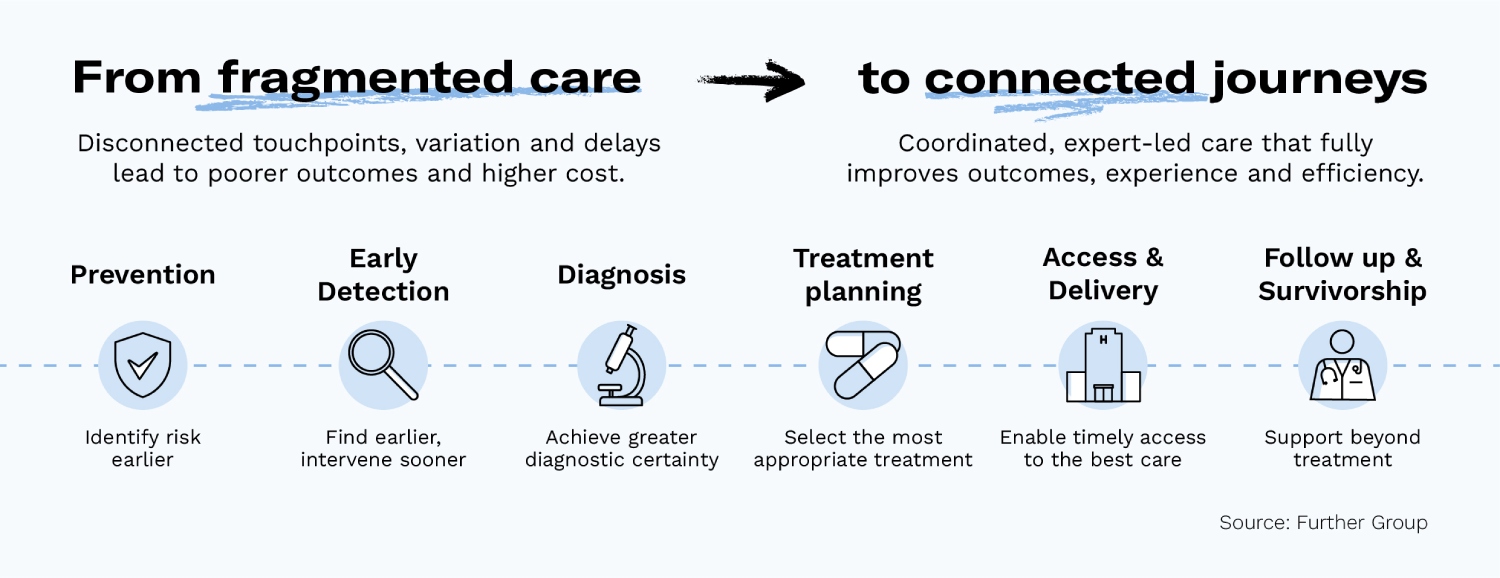
Because cancer risk is distributed across the pathway, it needs to be managed where value is either preserved or lost. In a connected model, care is organized as a journey where risk, outcomes and cost are actively managed at each stage. For employers, the practical question is how these stages are connected into a pathway that employees can access, navigate and remain supported through when they need it most.
Alongside expert case management to help connect each stage of care, align clinical decisions and reduce delays, four intervention points are particularly important:
- Identifying risk earlier
Prevention remains one of the most underused levers in cancer care. Up to 40 percent of cancers are linked to modifiable risk factors, yet prevention is still not systematically embedded. More targeted, data-driven approaches can enable earlier detection and reduce future claims exposure. - Achieving diagnostic certainty
This is the point at which clinical quality and economic efficiency converge, where cost is either contained or permanently escalated. Modern oncology involves complex decision-making, yet access to molecular diagnostics and specialist expertise remains uneven. Diagnostic certainty requires a more integrated approach, combining comprehensive genomic profiling, international expert review and multidisciplinary input, evidence-based treatment alignment and clinical trial navigation. The value lies not in any single intervention, but in how these elements are combined to reduce uncertainty, avoid suboptimal treatment decisions and improve both outcomes and cost trajectories. - Enabling access to the right treatment
Even with the right diagnosis, outcomes depend on timely access to the optimal treatment. In practice, this can be constrained by capacity, geography and reimbursement limitations. Improving access to centers of excellence and specialized expertise helps ensure patients receive the most appropriate care from the outset. When clinically governed and fully coordinated, this becomes a powerful risk mitigation lever, reducing variability and improving long-term outcomes across complex, multi-year claims. - Supporting patients beyond treatment
Care does not end with treatment. Many patients require ongoing monitoring, management of side effects and structured return-to-work support. A connected model plays a role in continuity beyond treatment, supporting long-term health and productivity while reducing the broader impact on employers and healthcare systems.
A structural shift in managing chronic care
Care systems and workplaces are still struggling to manage conditions that require continuous, coordinated support rather than episodic intervention.
Across chronic diseases, value is not created at the point of highest spend, but through how effectively care is delivered and managed across the full journey, from early intervention to long-term support. Coordination is what determines whether value is realized.
Employers and insurers therefore have increasingly important roles to play, moving from reacting to claims to actively managing care pathways. In practice, this means enabling earlier intervention, supporting more integrated care pathways and improving how people are guided across increasingly complex systems.
Beyond funding care, they can help improve how individuals access, navigate and experience it. This is what will enable more predictable costs, better workforce participation and more effective management of chronic risk over the long term.
Olfa Khechine is the Health & Wellbeing Proposition Lead at Zurich Global Employee Benefits Solutions.
Ana Antunes is the Chief Operating Officer at Further, a healthcare services provider specializing in cancer care management, treatment navigation and support services for individuals living with serious and chronic conditions.