
Travel & Tourism Development Index (TTDI) 2026: Rankings, trends and key findings
TravelArticleSeptember 25, 2026
The World Economic Forum’s Travel & Tourism Development Index (TTDI) 2026 benchmarks tourism development conditions across 110 economies.
Travel and tourism is booming again. International tourist arrivals reached a new high of 1.5 billion in 2025, visitor spending continued to rise, and travel and tourism’s total economic contribution reached a record USD 11.6 trillion. Yet the World Economic Forum’s Travel & Tourism Development Index (TTDI) 2026, produced in collaboration with Zurich Insurance Group, suggests that the sector’s biggest challenge has changed. The issue is no longer generating demand, but managing growth.
The latest TTDI shows that tourism development conditions are at their strongest since the pandemic. Between 2024 and 2026, 92% of the 110 ranked economies improved their score, driven by stronger cultural attractions, tourism infrastructure, visitor services and air connectivity.
However, rising costs, workforce skill shortages, investment pressures and sustainability challenges are making it harder for destinations to convert growing visitor demand into lasting value. The TTDI 2026 argues that the destinations best positioned for long-term success will be those that can balance growth with resilience, sustainability and effective destination management.
What is the Travel & Tourism Development Index 2026?
The TTDI 2026 benchmarks the conditions that enable sustainable and resilient tourism development across 110 economies. The 2026 edition builds on the 2024 report and provides a benchmark for governments, tourism organizations, investors and businesses.
Importantly, the TTDI does not rank countries based on visitor arrivals, spending or tourism revenue. Instead, it evaluates the factors and policies that help destinations attract, support and sustain tourism over the long term.
The Index assesses economies across 17 pillars, covering areas such as safety and security, digital readiness, tourism policy, transport connectivity, visitor infrastructure, natural assets, cultural resources, business travel infrastructure and sustainability. Together, these indicators provide a picture of how prepared destinations are to support future tourism growth and adapt to changing economic, environmental and geopolitical conditions.
What are the key findings from TTDI 2026?
Tourism development conditions are at their strongest since the pandemic
The 2026 report finds broad-based improvement across the tourism sector. Average TTDI scores increased by 2.1% between 2024 and 2026, representing the fastest pace of improvement since 2019. The strongest gains were in cultural attractions, tourism infrastructure and services, and air connectivity, reflecting stronger assets and systems that underpin tourism growth.
Advanced economies continue to lead
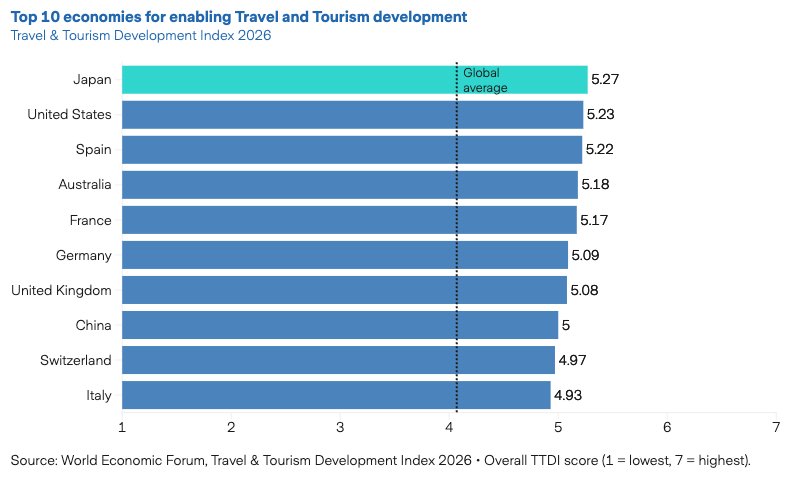
Japan tops the 2026 rankings, followed by the U.S., Spain, Australia and France. Advanced economies account for nine of the top 10 positions, with China the sole exception. European economies hold six places in the top 10, underlining Europe and Eurasia’s position as the highest-performing region overall.
Asia-Pacific and emerging tourism economies are gaining ground
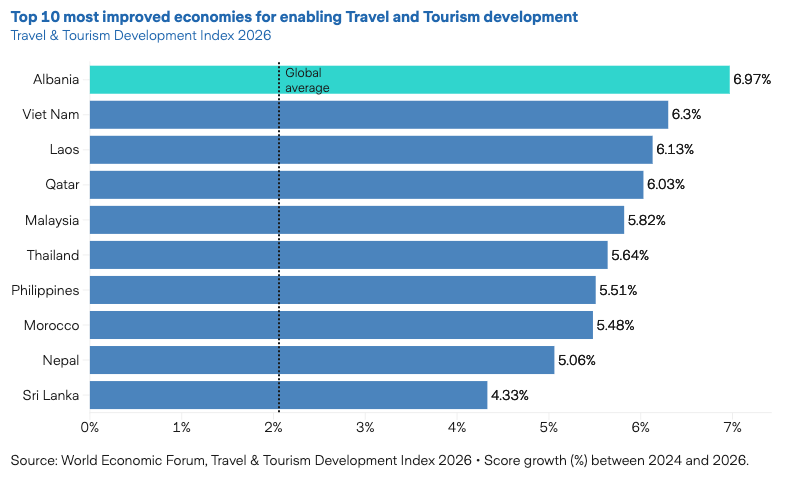
Some of the strongest momentum is now coming from emerging tourism economies.
Since 2019, the 10 largest emerging tourism economies have improved their TTDI scores more than twice as fast as the overall Top 20. Asia-Pacific is driving much of this momentum, accounting for seven of the 10 fastest-improving performers, while Albania was the most improved economy between 2024 and 2026.
These gains reflect growing investment in tourism infrastructure, improved connectivity and the continued development of natural, cultural and non-leisure tourism assets. The results also highlight the growing importance of emerging markets in the future of global tourism growth.
Affordability, investment and workforce gaps are among the biggest constraints
Travel and tourism-related prices have risen faster than inflation in many economies, contributing to a decline in price competitiveness in three-quarters of TTDI-ranked economies between 2024 and 2026. Meanwhile, tourism investment has lagged demand since 2022, while workforce shortages and skills gaps risk constraining service quality and adaptation to digital and AI-driven change.
Tourism growth is not automatically translating into broader benefits
While travel demand and visitor spending continue to grow, the economic and social value generated by tourism weakened between 2024 and 2026, while pressures linked to crowding and concentrated visitor demand remain above pre-pandemic levels. As a result, managing growth is becoming as important as generating it, requiring destinations to share tourism's benefits more widely while limiting pressure on communities, infrastructure and natural assets.
Regional performance
Europe and Eurasia remains the highest-performing tourism region overall, accounting for six of the world’s top 10-ranked economies. However, Asia-Pacific was the fastest-improving region between 2024 and 2026, with average scores increasing by 3.6%, compared with 2.5% for the Middle East and North Africa and 1.8% for Europe and Eurasia.
Asia-Pacific’s improvement was driven by stronger air transport infrastructure, cultural resources and business travel-related assets, reflecting the region's continued post-pandemic recovery. The Middle East and North Africa also recorded significant gains, particularly in tourism infrastructure and services.
Western Europe, Southern Europe and Eastern Asia-Pacific were the three highest-performing sub-regions overall. Western and Southern Europe benefited from leading tourism infrastructure and services, while Eastern Asia-Pacific stood out for its strong natural resources and connectivity.
The next phase of tourism development
The central message of TTDI 2026 is that tourism has largely moved beyond recovery. International arrivals, visitor spending and tourism development conditions have all surpassed pre-pandemic levels.
The challenge now is ensuring that growth creates lasting value. According to the report, the destinations best positioned for long-term success will be those that can diversify demand, protect access and connectivity, compete on value rather than price alone, manage tourism growth sustainably and strengthen workforce capacity.
As tourism enters its next phase, success will increasingly depend on resilience, sustainability and effective destination management as much as attracting visitors. In short, TTDI 2026 suggests the future of tourism will be defined less by generating demand and more by managing growth.
Frequently Asked Questions