Ignoring mental health issues could result in costs of up to 5% of GDP by 2030
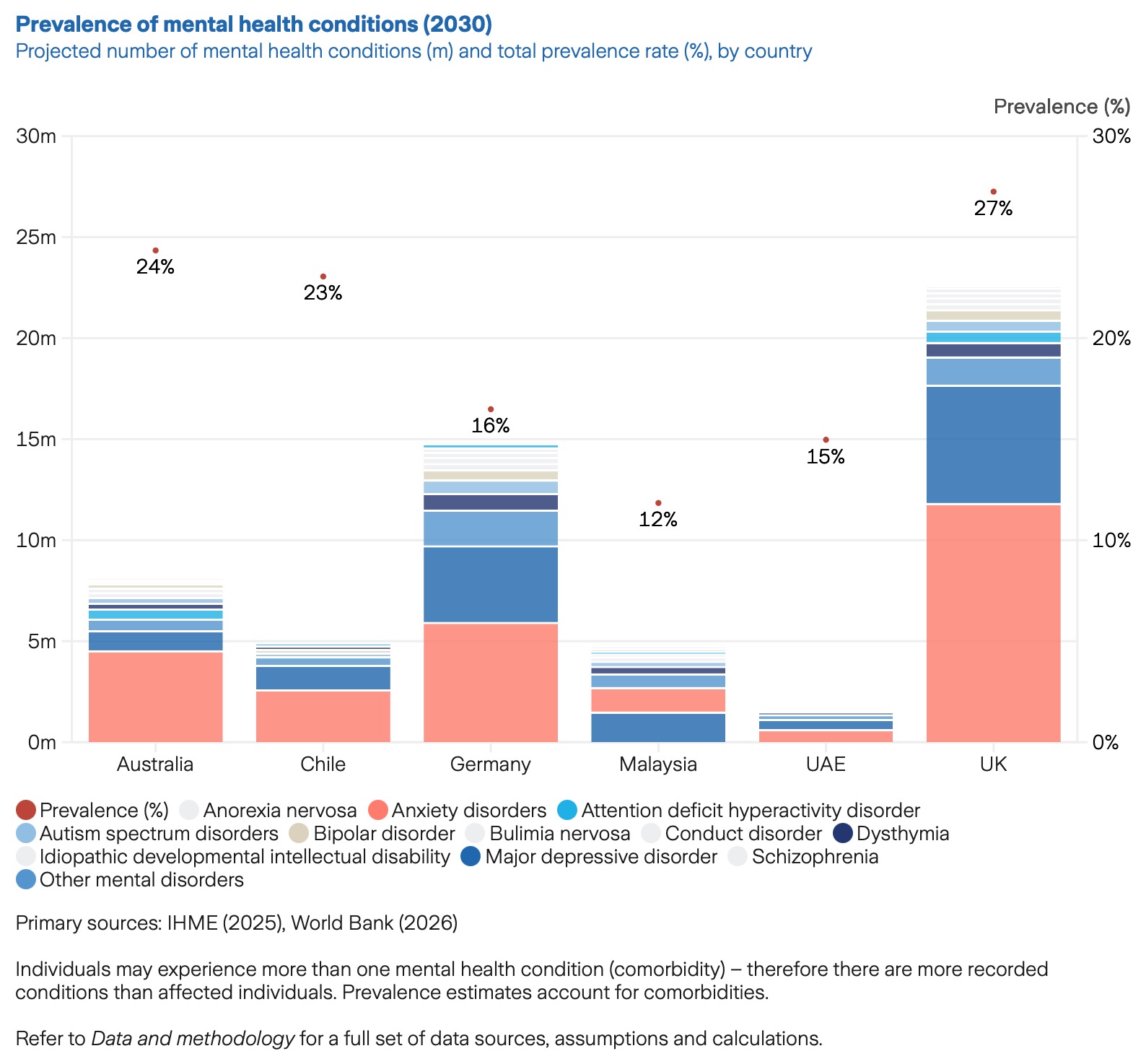
Mental health conditions are a major but often underestimated economic risk. Their impact is felt long before it shows up in health systems or public budgets. In some countries, around one in three working-age adults are projected to be living with mental health conditions by 2030, with overall productivity impacts approaching 5% of GDP.
The Value of Mental Health by Zurich Insurance Group (Zurich), shows that the biggest costs of mental illness often sit outside formal protection systems. Across six countries analyzed – Australia, Chile, Germany, Malaysia, the United Arab Emirates and the United Kingdom – the burden falls heavily on individuals, families and employers, through losses in wellbeing and productivity that can far exceed formal mental health spending.
As mental health challenges increasingly impact economies at a structural level, it’s essential for companies to play their part in building resilient protection systems. In our experience, around one third of our customers’ employees who receive early support through Zurich’s rehabilitation services can stay in work, rather than leaving the workforce altogether. That is why business leaders should act sooner – to prevent early distress from turning into long term workforce and social disengagement.
Alison Martin, CEO Life, Health and Bank Distribution
A burden felt first by people and families
Across the countries examined, people living with mental health conditions are projected to lose between 60 and 67 days of healthy life each year. At national level, this amounts to 0.3 to 2.9 million years of healthy life lost annually per country,1 accounting for about 7% to 14% of overall wellbeing losses across all causes. This burden is comparable to that of all cancers combined (around 6% to 19%) in most countries.
When formal systems struggle to respond early, care increasingly shifts to families and communities. Depending on the country, this can mean up to 1,275 hours of informal care per year, a substantial but mostly invisible burden that rarely appears in official statistics.
The widening employment gap
The largest economic impacts are not driven by short‑term sick leave, but by a widening employment gap – the difference in employment rates between people with a mental health condition and those without. Across countries, people living with mental health conditions are significantly less likely to be in employment as they leave jobs, struggle to return, or never enter the workforce in the first place.
This gap is particularly pronounced where mental health challenges emerge earlier in life. In several countries, conditions are increasingly identified before or at the point of labor market entry, increasing the risk that early distress disrupts first jobs, skills formation and long‑term attachment to work. In some countries, the employment gap is as high as 29%.
As automation and AI reshape entry routes into work – reducing routine roles and raising skill requirements – these pressures are expected to intensify. This makes early support, adaptable pathways and resilience at key career transitions increasingly critical to prevent temporary distress from becoming lasting labor market disengagement.
Earlier action matters
Across labor markets, the pattern is clear: awareness is growing, but support often comes too late – after distress has already translated into impaired functioning, absence or disengagement. By then, the costs extend well beyond health systems, falling on individuals, families and employers.
The report points to a clear opportunity to act earlier. This includes faster access and better triage, practical stay at work and return to work pathways, as well as reducing the silent shift of pressure onto households and workplaces when formal support fails.
Across countries and models, the message is consistent: earlier action prevents short term distress from turning into long term disengagement, while protecting wellbeing, participation and resilience at the same time.
Key findings at a glance
- In higher visibility markets, prevalence is rising fast, with around one in three working age adults affected in Australia and the UK by 2030.
- People with mental health conditions lose around two months of healthy life each year (60–67 days).
- This amounts to 0.3–2.9 million healthy life years lost annually per country, accounting for about 7% to 14% of overall wellbeing losses across all causes.
- Across the six markets, the total wellbeing cost approaches USD 1 trillion annually (USD 24bn–403bn per market).
- In some countries, wellbeing losses are up to 49 times higher than formal mental health spending.
- Productivity losses could approach 5% of GDP by 2030, driven mainly by people dropping out of the workforce.
- Families and individuals carry a large share of the burden, with out of pocket costs covering up to 43% of treatment and up to 1,275 hours of unpaid care per year.
1 The impact of living with mental health conditions is measured in years of healthy life lost using Disability Adjusted Life Years (DALYs). This includes morbidity (Years Lived with Disability) and mortality (Years of Life Lost). One DALY represents the loss of the equivalent of one year of full health.
About the research
The Value of Mental Health report analyzes public data to assess the current and future impact of mental health conditions in Australia, Chile, Germany, Malaysia, UAE and the UK, representing emerging and developed markets. The report measures effects on people, productivity, and protection systems through 2030, using metrics like years of healthy life lost, workforce participation gaps and system level costs.
Further Information
The Value of Mental Health report can be found here.
Downloads
Contacts
- Media Relations
Zurich Insurance Group (Zurich) is a leading global multi-line insurer founded more than 150 years ago, which has grown into a business serving more than 82 million customers in more than 200 countries and territories, while delivering industry-leading total shareholder returns.
Reflecting its purpose to ‘create a brighter future together,’ Zurich offers protection services that go beyond traditional insurance, to support its customers in building resilience. Since 2020, the Zurich Forest project has supported reforestation and biodiversity restoration in Brazil’s Atlantic Forest.
The Group has more than 65,000 employees and is headquartered in Zurich, Switzerland. Zurich Insurance Group Ltd (ZURN) is listed on the SIX Swiss Exchange and has a level I American Depositary Receipt (ZURVY) program, which is traded over-the-counter on OTCQX. Further information is available at www.zurich.com.