
Strategic framework
Focusing on the things that matter for our business
Enabling our customers to build resilient futures
The world around us is changing rapidly, and the risks continue to rise. Climate instability, economic uncertainty and social pressures all reinforce one another, making our role as an insurer, investor and risk manager even more important.
We believe that a dual imperative of supporting a successful climate transition while enhancing societal resilience is fundamental to a more prosperous future that will ultimately benefit our customers, the companies we invest in, and our own business.
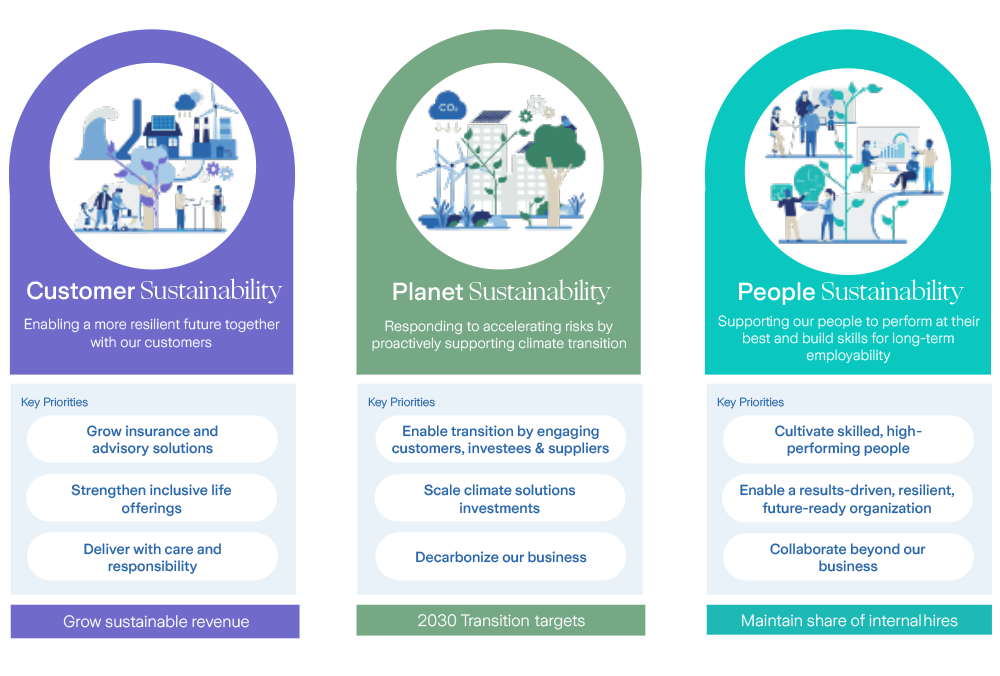
Our Sustainability Framework
Zurich’s role – from insurance and risk engineering to responsible investment – is becoming more valuable for customers as they face an increasingly risky world. By turning uncertainty into resilience, we will play our part in shaping a future where stability and sustainability go hand in hand. This is why our Sustainability Framework continues to draw on our deep risk management expertise and strong customer focus. Supported by our high performing workforce, it prioritizes action across three lenses: Customer, Planet, and People.
Our Sustainability Framework outlines our key priorities for 2026-2027. It helps build clarity across the organization on how we deliver our sharpened ambition: enabling our customers to build resilience futures.
Materiality: what matters most to us
In order to help inform our strategic sustainability priorities, we regularly consider what sustainability topics are most material for Zurich by bringing together insights from across our organization, key stakeholders, and benchmarking peers. In 2025, we reviewed our Double Materiality Assessment (DMA) to assess whether any topics have changed materiality relative to the comprehensive, bottom-up evaluation conducted in 2024, that was aligned with CSRD standards.
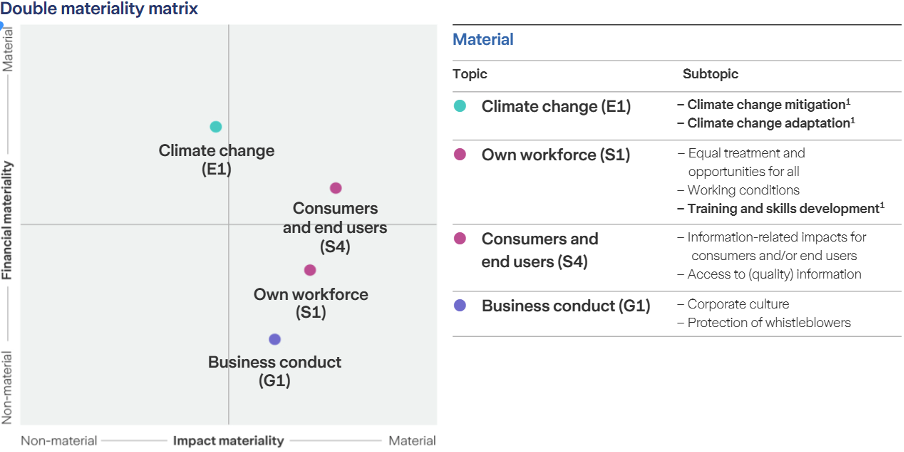
1 Reinforced topic through our 2025 DMA review.
Our 2025 review confirmed no significant changes to the overarching materiality established in 2024. Our review has reinforced the importance of three key material subtopics:
- Climate change mitigation (E1) - Diverging national climate commitments could reduce the pace of mitigation in the real economy, impacting delivery of emissions reduction targets. Accelerating impacts of climate change reinforce the critical importance of proactive mitigation measures across our business.
- Climate change adaptation (E1) - Increased public focus on climate adaptation and resilience building in the face of physical climate risks intensifying, has reinforced this topic's materiality. Stakeholder expectations for insurers to actively contribute to adaptation planning continue to grow
- Training & skills development (S1) - Our digital transformation priorities and AI integration initiatives progress, the critical importance of upskilling our workforce on the topics of data literacy, responsible AI practices and AI methodologies are reinforced.
Moving forward, we will continue to monitor ongoing and emerging trends that likely influence the risks, opportunities and impacts associated with the specific subtopics that affect our business and stakeholders.
Governance and performance management
Sustainability is integrated into our business, underpinned by strong risk management, governance, and advocacy for supportive frameworks, government policies and regulations that enable resilience and transition.
To inspire focus, we embed sustainability metrics into core performance management processes, and our most senior leaders’ objectives and incentives.
We have set key Group-wide sustainability targets across our framework and disclose our yearly performance within our comprehensive sustainability report. For our up-to-date performance, please read more in our Sustainability Report 2025.
We report against the most respected sustainability reporting standards and participate in a number of ratings and indices, such as FTSE4Good, EcoVadis, ISS, MSCI ESG and Sustainalytics.
Signatories
We believe sustainability is too complex and interconnected a topic to be tackled on our own. Therefore, we have become a signatory of a number of global initiatives that help us advance our work in collaboration with industry and global peers.
Zurich became a signatory to the Principles for Responsible Investment (PRI) in July 2012. This UN supported global investor initiative, is designed to provide a framework for better integration of environmental, social and governance factors into investment practice.
Zurich joined UN Net-Zero Asset Owner Alliance as a founding member in 2019, committing to a net-zero-emission portfolio of investments by 2050.
The United Nations Environment Programme Finance Initiative (UNEP FI) Principles for Sustainable Insurance (PSI) serve as a global framework for the insurance industry to address environmental, social and governance risks and opportunities. Zurich became a signatory in 2017.
Zurich Santander Insurance America is a member of the UNEP FI Principles for Sustainable Insurance through the membership of the Zurich Insurance Group. Zurich Santander Insurance America is a joint venture between Zurich and Banco Santander created in 2011, with Zurich being the majority owner. Read more about sustainability at Zurich Santander in the Zurich Santander Sustainability Report 2024.
Statement of continuing support
Zurich became a signatory of the UN Global Compact in July 2011 because we believe that being a responsible company is fundamental to our long-term sustainability. As a signatory, we are committed to aligning our strategy, culture and day-to-day operations with the Global Compact’s 10 universally-accepted principles in the areas of human rights, labor, environment and anti-corruption.
The principles of the Global Compact complement our purpose, values and Code of Conduct, and all Zurich employees are expected to live up to them. We are committed to embracing, supporting and enacting these principles within our sphere of influence, and we will regularly communicate our progress.
Zurich is a founding member of WEF’s Good Work Alliance, a global, cross-industry group of forward-thinking companies striving to build a more resilient, equitable, inclusive and human-centric future of work.