Why critical infrastructure is a ticking time bomb
Global risksBlogJanuary 14, 2026
Critical infrastructure is dangerously overlooked. Despite threats from extreme weather, cyberattacks and conflict, the Global Risks Report ranks disruptions to critical infrastructure low. Leaders must act fast.
- Critical infrastructure remains highly vulnerable to top risks identified in the Global Risks Report 2026, such as extreme weather, state conflicts and cyber threats.
- But the findings also reveal a troubling gap: “disruptions to critical infrastructure” ranks strikingly low at only 23rd over the next decade.
- The pressing challenge is to shore up the foundations of our economies and societies.
The world is entering an “age of competition.” That’s the conclusion of the World Economic Forum’s (WEF) Global Risks Report (GRR) 2026. From state-based armed conflict to cyber insecurity and extreme weather, the latest edition highlights a complex mix of interacting risks as the institutions designed to manage them struggle to keep pace.
Within this crowded agenda, risks to critical infrastructure – like energy, water and digital systems – are, in my view, often underplayed. People overlook these risks until a major incident captures headlines.
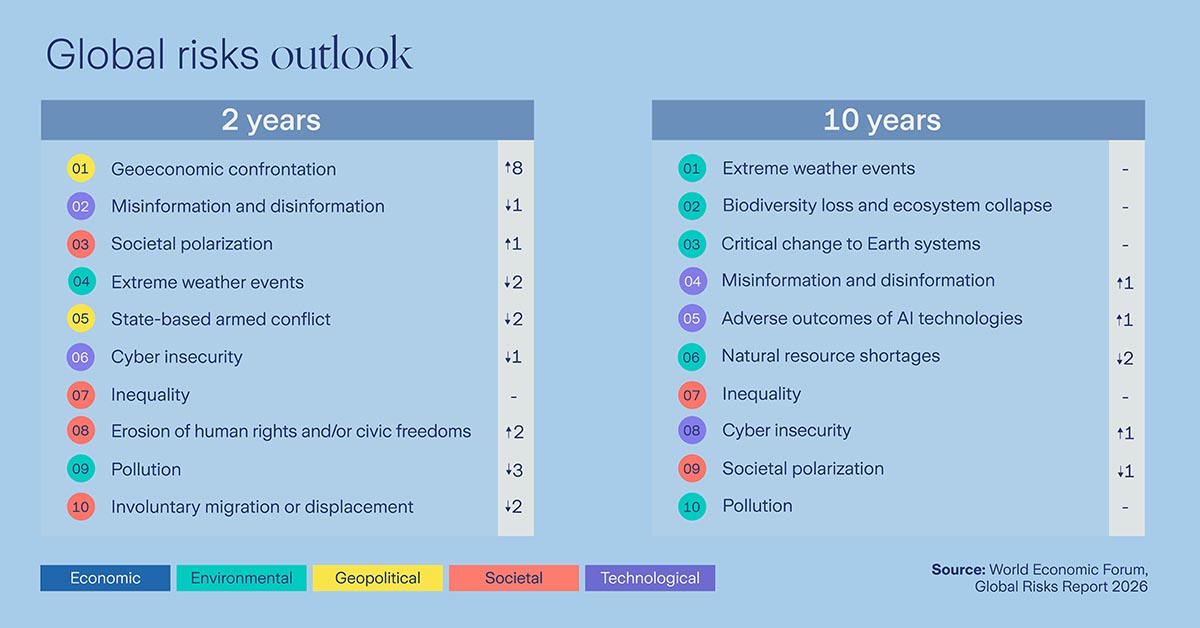
The latest GRR shows some awareness of these growing challenges, but many vulnerabilities still go unnoticed. In the expert survey, “disruptions to critical infrastructure” ranked just 22nd for the next two years and 23rd for the next 10 years. That’s strikingly low for something so fundamental to modern life. I fear that this is a dangerous oversight: When infrastructure fails, the systems that depend on it can fail, too.
Huge structural issues like demographics and public finances aren’t showing up in people’s perceptions. These risks are real, long‑term, and unavoidable — yet they aren’t getting the attention they deserve.
The impact of extreme weather
Despite being pushed down the rankings over the two-year period, extreme weather remains a top concern over the next decade.
Climate change is already testing critical infrastructure in ways that were not anticipated when many systems were designed. Power grids face rising demand for cooling at the same time as heat waves strain equipment and reduce efficiency. Hydropower faces risks from both extremes: flooding can overwhelm and damage infrastructure, while severe droughts can halt generation altogether.
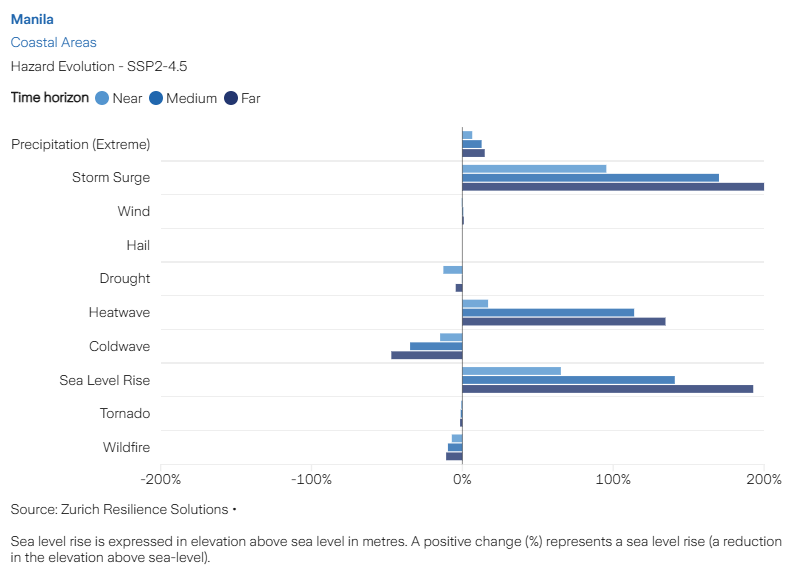
Coastal infrastructure – including in major “sea cities,” such as Singapore, Jakarta and Manila – is particularly exposed to climate hazards such as rising sea levels and flooding. These cities are vital hubs, and disruptions could quickly ripple through global supply chains and financial markets.
On the front line
Infrastructure also remains a primary target in conflict. Undersea communication cables can be cut. Satellites can be jammed. Drones can threaten critical facilities. Access to essential resources – food, water, energy – can be weaponized in geopolitical disputes.
Digitalization is morphing this into a hybrid threat, with cyber insecurity also among the top 10 risks over the next decade. Connected infrastructure, such as grids, ports, and pipelines, offer a wider attack surface for both criminal groups and state-linked actors. A successful cyberattack on an energy system or air traffic control network, for example, can have cascading effects far beyond the initial point of failure, amplifying other physical or geopolitical shocks.
The quiet infrastructure crisis
In addition to these dramatic risks, the GRR also reveals a troubling gap: We are still not paying sufficient attention to less visible, systemic threats that could prove equally devastating, like, for instance, the slow crumbling of critical infrastructure, which requires major overhauls just to remain fit for purpose. Take electrical grids. In much of the OECD, these are old, under-resourced and difficult to upgrade or expand in the face of rising demand.
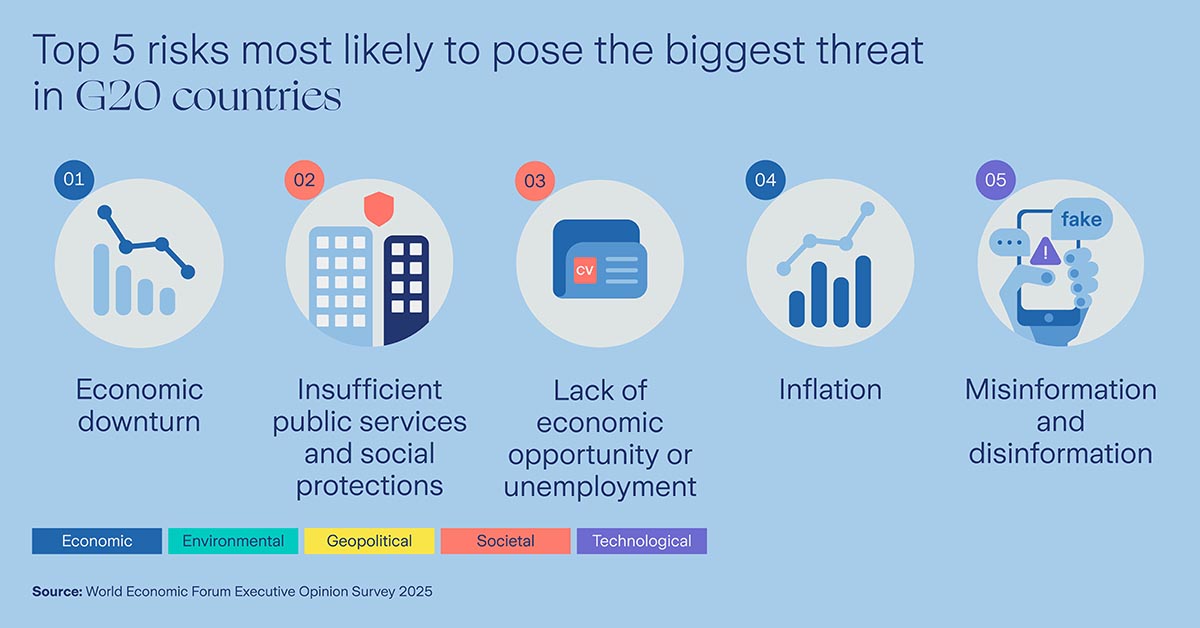
Part of the challenge lies in another underestimated risk: insufficient public finance. Economic risks do not feature among the top 10 global risks over either the two-year or 10-year time frame, even though many governments are grappling with rising debt, and business leaders polled in the WEF’s Executive Opinion Survey were preoccupied by the threat of a downturn.
When the economy falters, every other risk becomes harder to manage, including those linked to critical infrastructure. Economic capacity is more than just a means to fund essential maintenance and upgrades; it acts as a shock absorber, helping countries repair damage, invest in prevention, and drive climate and digital transitions. In the same way, critical infrastructure is exposed to a set of risks – but it also underpins our ability to manage a broader spectrum of threats.
The need for a holistic view
I think part of the problem lies in the notion of how we think about risk. Our focus on the immediate crisis can lead us to postpone preventative steps (like maintenance) for yet another year. Views are too often siloed. Climate and financial sustainability, for example, are sometimes treated as separate issues and addressed via different strategies. Risks perceived as more dramatic – conflict, pandemics, extreme weather – often push less obvious but equally critical threats out of view.
This fragmented approach fails to account for a fundamental reality: The spectrum of global risks is interrelated. The challenge facing critical infrastructure brings this into focus. Geopolitical tensions, technological disruption and social instability all converge on the same underlying systems. A power grid under strain from heatwaves may also be vulnerable to cyberattacks. A port hit by flooding can amplify supply chain shocks and social unrest. Weak public finances limit the ability to mitigate or respond to any of these threats.
In an age of competition, our instinct can be to narrow our focus on the latest crisis. I believe that the pressing challenge – and opportunity – for governments and decision-makers is to do the opposite: to widen the lens, see how risks reinforce one another, and design dual- or multiuse solutions that strengthen several dimensions of resilience at once. Leaders must act early to shore up the foundations on which the stability of our economies and societies rely. Critical infrastructure is a critical risk. It’s time to treat it as such.
Zurich Resilience Solutions
Managing risk. Unlocking opportunity.
Our Climate Resilience experts help you identify and manage climate risks, and prepare you for climate reporting.