
Why personal resilience belongs in the boardroom
PersonalBlogJanuary 21, 2026
Burnout, mental health and financial stress are rising. Research shows personal resilience isn’t a “soft skill” – it’s a hard-edged business imperative that drives wellbeing, productivity and retention.
- The Global Risks Report 2026 identifies social fractures as among the most pressing threats to economies – and the people who power them.
- Evidence from almost half a million employees shows that personal resilience is a critical driver of workplace wellbeing.
- Research from the University of Oxford finds that companies investing in wellbeing and resilience gain measurable advantages in productivity, talent retention and performance.
One message stands out to me from the World Economic Forum’s (WEF) latest findings. We’re facing a series of interconnected threats, not just to the economy or infrastructure, but to our most valuable resource: people.
For the second year running, the latest Global Risks Report (GRR) lists inequality and societal polarization among the top 10 global risks we’re likely to face over the next two- and 10-year periods. What’s even more striking are the results from the WEF’s most recent Executive Opinion Survey (EOS) of over 11,000 business professionals on country-level risks, where societal concerns are clearly weighing far more heavily than in past years.
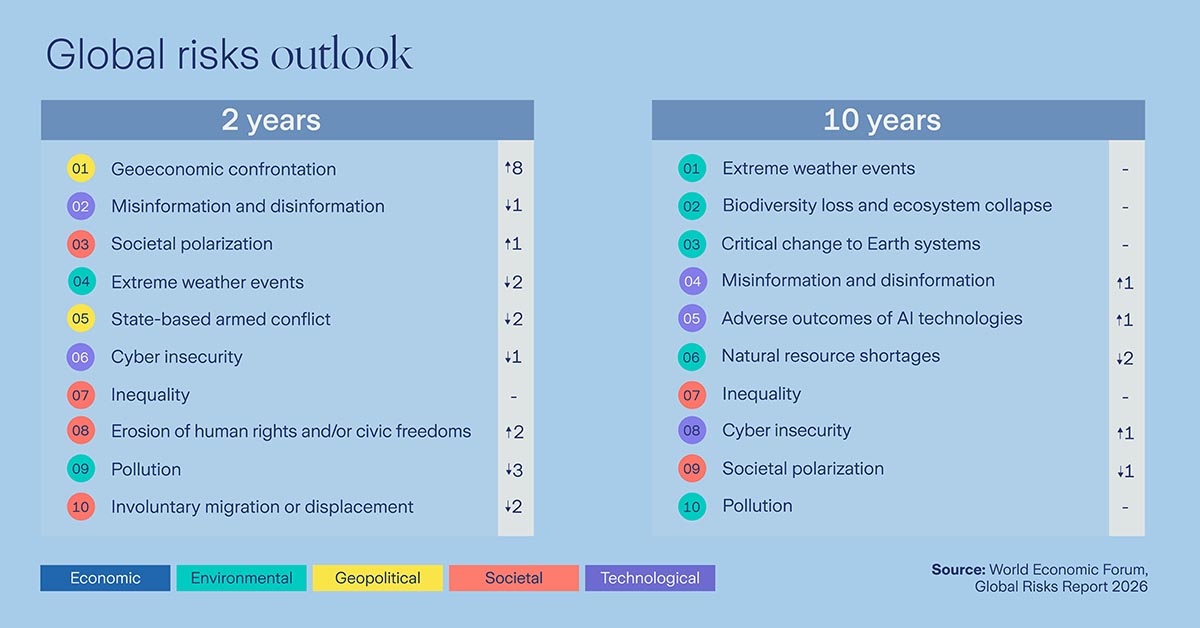
Weakening social safety nets and shrinking job opportunities rank among the top five risks among G20 countries as well as many others. Declining health and wellbeing was identified by several economies, including Australia, Germany and Canada, as one of their top concerns, signaling just how vulnerable people, families and businesses have become.
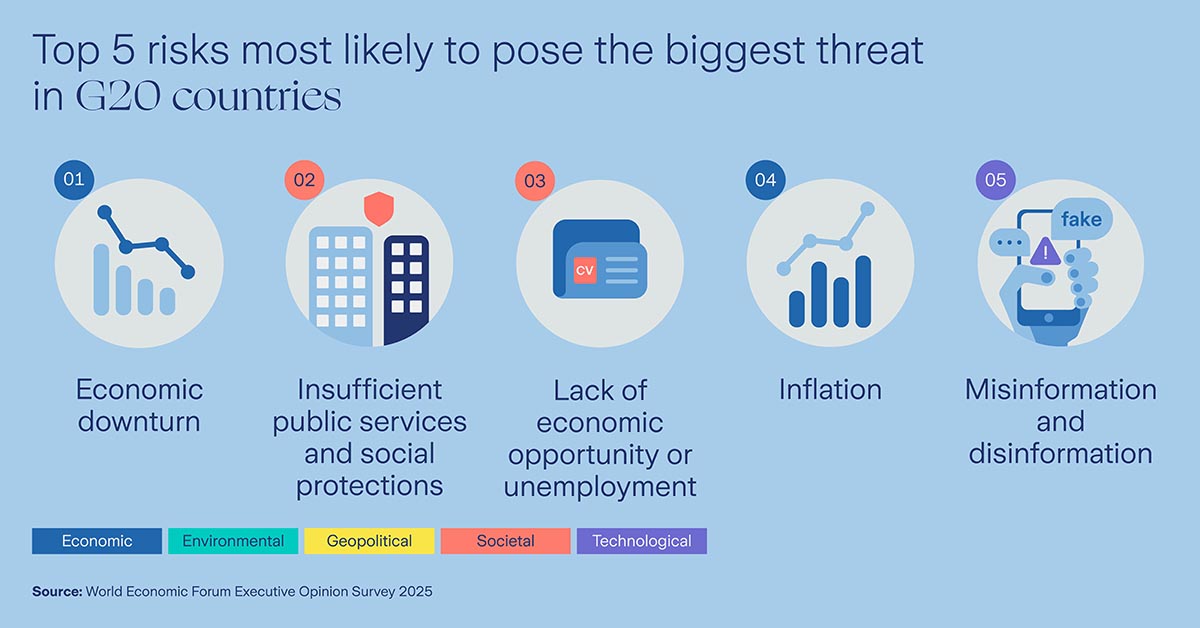
And it’s clear to me that these cracks in our social and economic foundations are affecting us at work. More people are worried about saving enough for retirement. Mental health conditions are leading to more time off work for more people, and are now a leading driver of disability claims. We’re seeing more cases of burnout, and absenteeism and presenteeism are on the rise.
Many of us feel stretched thin, at work and at home. We need to find ways to strengthen our resilience at every level – from individual to institutional – and that’s why personal resilience belongs on the leadership agenda.
Among G20 countries there’s been a real rise in concerns around weakening social safety nets and shrinking job opportunities. Mental health is now the top cause of disability and absenteeism. Personal resilience directly impacts business performance.
What is personal resilience?
How can we navigate challenges and adapt in ways that protect our wellbeing? Personal resilience has different dimensions – social, financial, physical, and psychological – which together influence how we respond to stress and disruption.
Resilience isn’t simply “toughing it out.” Building resilience is about creating conditions that help people adapt to adversity, recover from setbacks and maintain clarity, energy and perspective, even when the pressure is on. When workplaces support personal resilience, it can help us bounce back faster, creating a ripple effect of strength and recovery that benefits families, communities and businesses.
The bottom line impact
We believe that supporting employee wellbeing and resilience is not only the right thing to do, it makes business sense. That’s why it’s been a core part of our People Sustainability aspiration at Zurich for many years. And recent research backs this up.
A 2025 meta-analysis covering nearly 300 studies and more than 430,000 employees shows that personal resilience directly improves wellbeing. And in turn, rigorous academic research reveals that increased employee wellbeing translates into measurable results for companies, including:
- Productivity: Call center staff who described themselves as feeling “very happy” made up to 12 percent more sales when they felt “very unhappy.”
- Talent attraction and retention: Organizations with higher workplace wellbeing saw a third less employee turnover.
- Profitability and company valuation: A portfolio of 100 firms with the highest wellbeing scores between 2021 and 2024 outperformed major benchmarks such as the S&P 500, Nasdaq Composite and Russell 3000.
Taken together, these studies confirm what many business leaders instinctively feel: Employees who are happier and healthier are more productive, more loyal and less likely to miss work or work while unwell. This translates into increased profitability and improved stock market performance, and stronger company valuations.
Building personal resilience
To build personal resilience, we must first understand and measure it. That is why we are partnering with the University of Oxford’s Wellbeing Research Centre to develop a Personal Resilience Index. Drawing on insights from more than 130 academic papers, this tool will look at four key dimensions – social, financial, physical and psychological – to help individuals and organizations capture and explain resilience levels.
It will also show where support is needed. Employers have a critical role in embedding resilience into their culture and operations, and proactive measures have the potential to protect both people and performance. This concept is at the heart of our own People Resilience Framework at Zurich, which includes giving our employees access to smart work tools, resources and employee benefits across all four dimensions of personal resilience. As Jolanda Grob, Group Chief People Officer at Zurich Insurance Group highlights, "the framework’s goal is to achieve sustainable high performance while ensuring our people remain engaged, healthy and resilient for what's ahead."
And as an insurer, Zurich has a distinct role to play as well – offering life and health coverage, financial education and mental health support to help build sustainable wellbeing. Because, as the evidence shows, financial, psychological and physical health are closely connected.
Building personal resilience enables individuals to navigate an uncertain world with more confidence. It helps employees to stay more engaged and productive today, while equipping them – and the companies they work for – with the capabilities to navigate the stresses and shocks that the WEF’s latest findings warn may lie ahead.
Personal resilience at the heart of business is not a soft slogan – it’s a strategic necessity that protects both people and the bottom line.