
Helping people adapt to change makes businesses stronger
PersonalArticleSeptember 23, 2026
In conversations with employers, one question comes up again and again: how do we help people keep performing when the demands on them keep changing? The answer is not to expect more endurance from individuals. It is to make sure people have the confidence, support and skills they need to adapt well.
That is how I think about resilience: not as a slogan, and not as something employees should have to find entirely within themselves. It is shaped by the conditions around people – their financial confidence, physical and mental wellbeing, social connections, relevant skills and digital confidence.
This is the focus of Zurich’s Global People Resilience Study 2026, developed with Oxford Research & Development Partners. The study helps make resilience more practical for employers by showing where support can improve both people outcomes and business performance.
Resilience shows up in performance
For companies, this matters now because change is no longer a temporary phase to manage through. It is becoming the environment people work in every day. Cost of living pressure, health concerns, skills shifts and digital transformation – all affect how people show up at work – and how well businesses can execute.
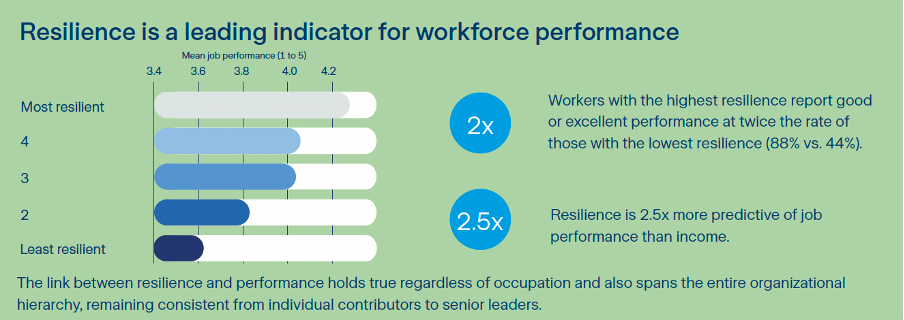
The link to performance is clear:
- Workers with the highest resilience report good or excellent performance at twice the rate of those with the lowest resilience (88% vs 44%)
- Resilience is also far more predictive of job performance than income.
- Highly resilient employees are much more likely to recommend their employer.
Making resilience practical for employers
That is why resilience belongs in business conversations. When people feel more secure and better supported, they are better placed to stay healthy, focused and productive through change. And when that happens at scale, it becomes a performance issue for the whole organization.
For employers, the opportunity is to make support easier to understand and easier to use. Benefits, protection, health services, learning and flexible working practices are most valuable when people know what is available, trust it and can act on it when it matters.
Financial resilience is a good example. Globally, it is the weakest of the five domains measured and where action has the biggest impact. Many people are not confident they could cover several months without income, and many are unsure whether their insurance protection meets their needs. That gives employers a clear chance to make financial wellbeing and protection more relevant, more visible and more actionable.
Digital confidence is becoming part of employability
Digital confidence is another area employers cannot ignore. As AI and other digital tools become more embedded in work, some people will adapt quickly while others may need more support. Building digital fluency is therefore not only about productivity today. It is about helping people remain confident, capable and relevant as work continues to change.
Turning resilience into business performance
The employers that make progress will be those that treat resilience as part of how work is designed, communicated and supported. Financial security, health, social connection, digital confidence and supportive teams all contribute to how people adapt, recover and keep performing when circumstances change.
That is the positive role employers can play: making resilience practical through support people can understand, trust and use. Because people do their best work when they feel supported, prepared and able to face change with confidence.
Key Takeaways
- Resilience is strongly linked to job performance.
- Resilience is more predictive of performance than income.
- Financial resilience is the weakest resilience dimension globally.
- Digital confidence is becoming increasingly important as AI and other digital tools transform work
- Resilience grows through practical support that helps people perform sustainably.