
Socioeconomic turbulence tops northern America’s risk agenda
Global risksArticleDecember 3, 2025
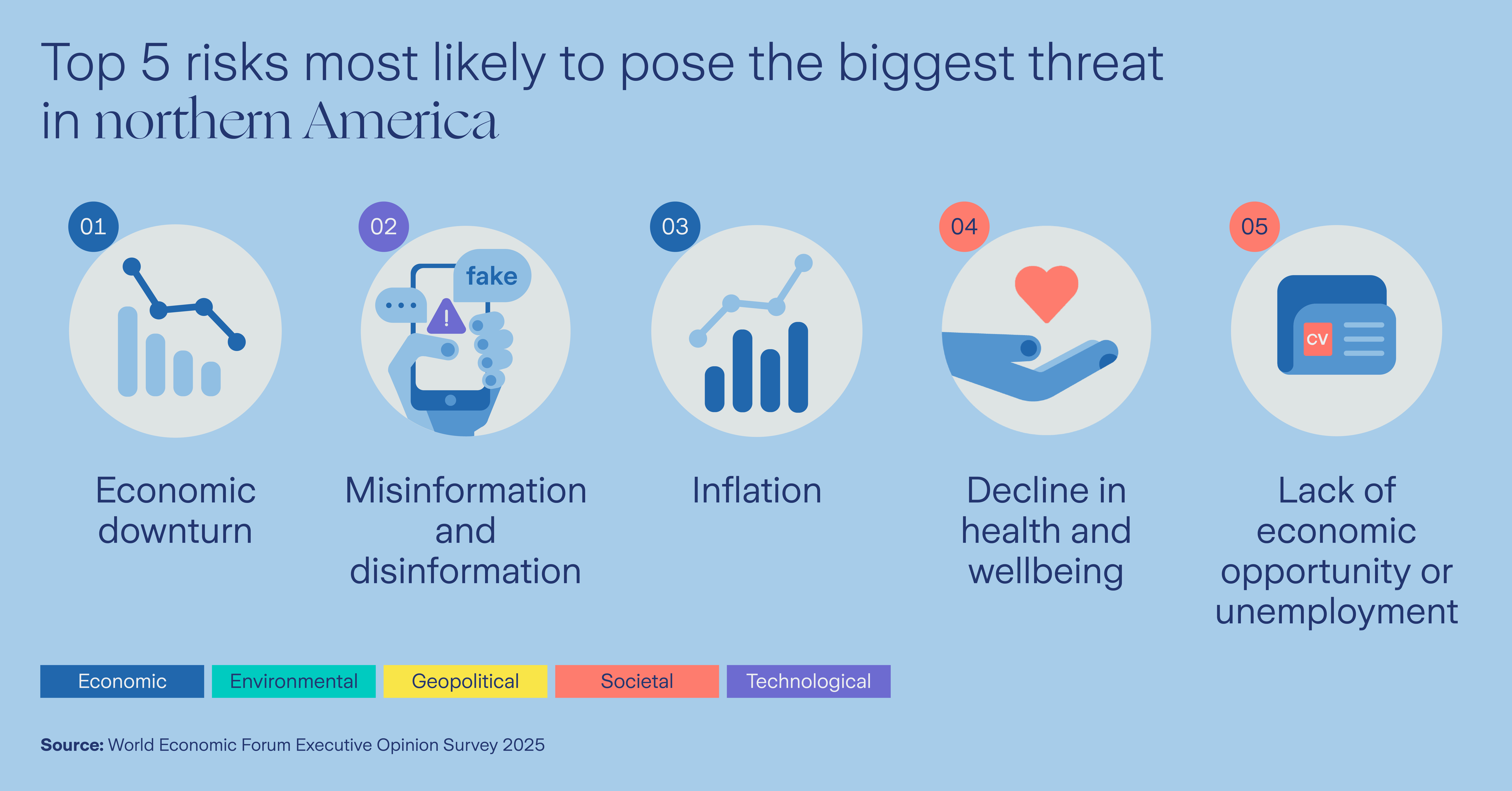
Business leaders in northern America are navigating a complex mix of economic, technological and social pressures, with the possibility of an economic downturn topping their list of concerns.
Economic worries top the World Economic Forum’s Executive Opinion Survey (EOS) 2025 for northern America, alongside misinformation and disinformation, decline in health and wellbeing and unemployment. The survey is based on input from more than 11,000 business leaders in 116 economies and reveals the five risks that most preoccupy executives around the world.
1. Fears of an economic downturn persist
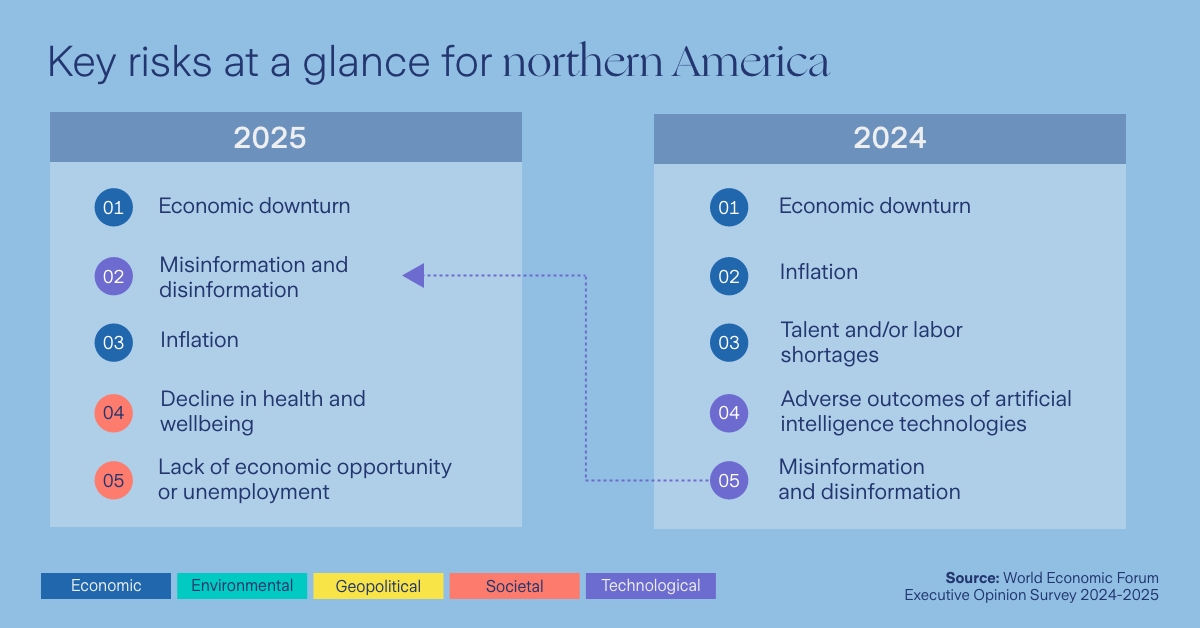
In northern America, economic risks dominate the radar. For the third year running, their top-ranked risk is “economic downturn,” which includes recession and stagnation.
The findings may reflect vulnerabilities such as high U.S. federal debt and continued tariff uncertainty. Reflecting geopolitical tensions, executives in the U.S. were more concerned than their Canadian counterparts by “disruptions to a systemically important supply chain,” rating this the fifth most significant threat.
Overall, the survey took place against a backdrop of faltering confidence in the economy as the threat of a downturn scored highly in every region.
| US | Canada |
|---|---|
| 1. Economic downturn (e.g., recession, stagnation) | 1. Decline in health and wellbeing |
| 2. Decline in health and wellbeing | 2. Inflation |
| 3. Misinformation and disinformation | 3. Misinformation and disinformation |
| 4. Adverse outcomes of artificial intelligence technologies | 4. Decline in health and wellbeing |
| 5. Disruptions to a systematically important supply chain | 5. Lack of economic opportunity or unemployment |
2. Concerns over false narratives
The second-highest risk for North American executives is misinformation and disinformation – up sharply from fifth place last year.
It has been over a decade since the WEF prominently featured the threat of “digital wildfires” in its 2013 edition of the Global Risks Report – and they continue to raise concern. Misinformation (defined by the U.N. as the accidental spread of inaccurate information) and disinformation (material that is deliberately spread to deceive) also rank among the top five concerns for executives in Europe and eastern Asia.
Amplified by generative AI, misinformation and disinformation are now a tangible business threat. From short-term investor panic to long-term reputational damage, false information has significant implications for business leaders and threatens social cohesion.
3. Inflation is still on the agenda
Inflation ranks third in the list for North American executives in this year’s survey, a drop of only one position compared with last year, with Canadian business leaders more concerned than their U.S. peers.
Looking ahead, the latest International Monetary Fund’s (IMF) World Economic Outlook projects that inflation in the U.S. will rise in the short term, describing the pass-through of tariffs to consumer prices as increasingly likely. North American leaders are not the only ones concerned about inflation: Despite the IMF expecting a decline in most countries, this risk tops the rankings in two regions – the Middle East and northern Africa, and Central Asia – and ranks second in Europe.
4. Declining health is a rising concern
A new entry in this year’s top five, “decline in health and wellbeing” – representing a major threat to productivity – is ranked fourth by North American business leaders. They are not alone: It emerged as a top risk in numerous G20 countries, including France, Germany and Australia.
More than three-quarters of U.S. adults now have at least one chronic health condition, and more than half have multiple conditions – proportions that have been trending upward for the last two decades.
Indicators of mental health in the U.S. are also worsening, with an estimated annual economic cost of mental illness at USD 282 billion. Linking the decline in wellbeing to financial worries, recent research finds that young people in Canada are especially likely to cite the rising cost of living as a reason for mental health problems.
5. Lack of economic opportunities
The top five concerns for North American executives are rounded out by another new entry this year: “lack of economic opportunity or unemployment.” This also ranks among the top five risks across all other regions, with the exception of Europe and eastern Asia, where labor shortages are the more predominant concern.
The Organization for Economic Co-operation and Development’s Employment Outlook 2025 finds “signs of a possible slowdown” in the U.S. labor market and “deteriorating employment prospects” in Canada.
While related to broader economic concerns, these results also come at a time when accelerating progress in AI is rapidly reshaping sectors that employ 80 percent of the world’s workers. According to EOS survey data, U.S. business leaders are more concerned than their Canadian counterparts by “adverse outcomes of artificial intelligence technologies,” which could include labor market disruption.
From risk to resilience
The results of the 2025 EOS highlight the inherent interconnectedness in the risk landscape. These five risks – economic downturn; misinformation and disinformation; inflation; declining health and wellbeing; and lack of economic opportunity or unemployment – can feed off one another.
Recognizing these risks is the first step toward preparing for them. This data, by shedding light on risk, can help guide business leaders toward viable solutions that minimize the fall-out of these threats.
About the data
This blog draws on select insights from the World Economic Forum’s Executive Opinion Survey, conducted across 116 economies and with 11,000 business leaders. Zurich Insurance Group is a WEF strategic partner.
Sources:
World Economic Outlook, IMF, October 2025
Preventing Chronic Disease, CDC, April 2025
Blueprint for a National Prevention Infrastructure for Mental, Emotional, and Behavioral Disorders, National Academies Sciences, Engineering, Medicine, April 2025
Jobs of Tomorrow white paper, World Economic Forum, October 2025