In-house and intense: Zurich takes fire protection training to the next level
BusinessArticleOctober 29, 2025
A new ‘fire protection safety boot camp’ is helping Zurich Resilience Solutions to train its experts and customers, aiming to make the world more resilient to fire risks.
How do you put out a fire in an enormous, eight-meter (26-foot) long industrial vat used for frying doughnuts? Ever ask yourself how sprinklers extinguish fires in cold storage where water would instantly freeze? What clue tells you that an oil filter on an engine used to supply water to fire sprinkler systems needs replacing?
These and a multitude of other questions will be front of mind as risk engineers from Zurich Resilience Solutions gather in a special new training facility in the Netherlands. The training center is run through a collaboration with Johnson Controls International (JCI). After opening in 2025, experts from ZRS can attend intense, two-week training courses at the facility, officially known as the ‘TechXchange Fire Suppression Center.’ Zurich’s customers can also schedule their own courses there with our experts to support them.
Aiming for resilience
The training center is the first in which Zurich Resilience Solutions, Zurich’s specialist risk advisory business, has directly invested. It is in addition to another facility it also uses in collaboration with JCI in the U.S. The facility in the Netherlands is part of a key piece in Zurich’s ambitions to make customers more resilient to risks. Zurich has a long history of working with customers in this way. It was already advising German factories on ways to improve safety in the nineteenth century. Building on its expertise gained over the more than 150 years it has been in business, by providing the right solutions, Zurich can help customers mitigate or even prevent losses, including those related to fire.
“The better we train our people, the better equipped they will be to identify and manage the key elements of fire control, ensuring that our customers are investing in fire protection systems that are fit for purpose, adequate, and reliable,” says Danaëlle Buriot Le Mao, Zurich Resilience Solutions’ Global Head of Property, adding, “This should ultimately help customers to reduce losses.”
One of two facilities
The new training center in Enschede (pronounced EN-sche-day), near the border to Germany, is set up on a JCI property, like the first such center Zurich established in collaboration with JCI in 2012 in Cranston, Rhode Island. Both are considered by Zurich to set an exceptional standard in an industry that otherwise often sends insurance specialists to external providers for training. Having Zurich’s own in-house specialists design and run the courses has several benefits: not only do the instructors know the ins and outs of fire protection systems, but they also have extensive insurance risk management experience.
Bringing training to life
“The insights we share go well beyond published standards. And, they are brought to life in training sessions. It’s a powerful way to illustrate the best solutions for specific challenges based on both proven performance and economic costs,” according to Stuart Lloyd, Zurich Resilience Solution’s Global Practice Leader for Fire Protection, who is one of Zurich’s top fire safety trainers at the centers.
The emphasis is on providing practical knowledge. “People have different ways of absorbing learning. Some people like to listen, some people like to read, some people like to touch, some people like to watch. These training facilities give you all of that,” says Lloyd. He joined Zurich UK in 2003, after spending over 15 years in the fire protection system industry, including many of those working as a sprinkler installer. Today, in addition to his leadership role at Zurich, and teaching, he sits on multiple fire protection system committees within well-known standard-setting bodies.
Value of hands-on training
According to Richard Gallagher, a former senior Zurich Resilience Solutions risk engineer who recently retired, before Zurich had a training center, fire safety risk engineers mainly attended dry courses in a classroom. “Death by presentation,” Gallagher calls it.
Gallagher notes that in real life, risk engineers are supposed to be strictly hands-off when visiting customer sites. Ignoring this rule can have disastrous consequences. For example, there was the fire safety risk engineer (not working for Zurich) in the U.S. who lifted a manhole cover to inspect two sprinkler main control valves. The cover fell into the shaft, sheering a 10-inch (25-cm) water main, causing flooding at a customer’s department store, which had to shut for three days. The hapless engineer’s insurance company bore the expense.
Advantages of two centers
Having two centers for training makes sense for Zurich, whose over 160 fire protection experts across 30 countries are part of Zurich’s total of over 1,000 risk engineers and experts in all areas across the globe. The Enschede center will primarily serve Europe, the Middle East and Africa (EMEA), as well as Asia Pacific and Latin American regions.
Beyond cutting down on travel time, having two centers also makes it easier to accommodate risk engineers who work with different standards. Those based in Europe, for example, are more familiar with equipment calibrated in centimeters and meters, and pressure measured in bar, while risk engineers in North America typically rely on inches, feet, and pounds per square inch.
Fire safety – a hot topic for customers
Customers are also welcome to participate in such courses, which can be tailored to their respective industries. Through experience, Zurich has found that the learning curve for customers attending its courses can be steep, and lead to a new-found awareness.
“The first day they come in, customers assume that it’s going to be a very basic course. But toward the end, awareness dawns, and we hear them on their phones during breaks demanding that someone in their office back home send them copies of contracts and service sheets. Some even demand an immediate review of all their company’s fire safety systems,” says Lloyd. “Many people think all such systems need only to be installed, and then basically forgotten. It’s really quite the opposite.”
Course details
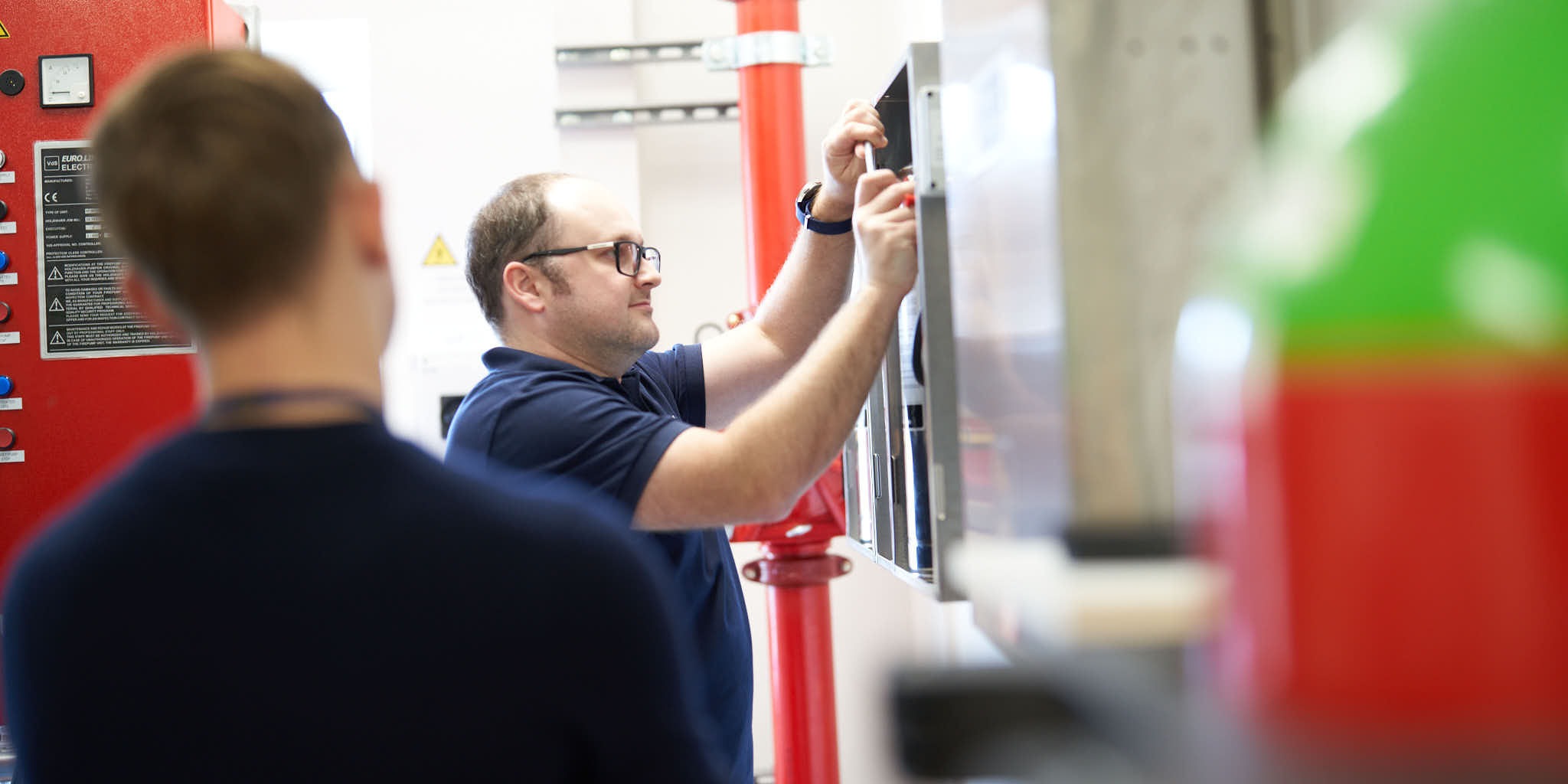
“We have an entire system in Enschede, so we can really demonstrate all the elements – from water supply in a tank, a pump, all the valves in between, and the pipes to the sprinklers, as well as the various sprinklers,” says Jan Willem Sollie, a Zurich Resilience Solutions senior risk engineer based in the Netherlands, who is also the training manager for fire protection and in charge in the Enschede facility. Sollie adds that the only aspect missing is an actual fire. Due to regulations, fires are not allowed at the Enschede facility, he says.
Standing next to a control panel, Sollie poses a typical course question: Suppose there’s a fire in a commercial facility. What should happen first? Should the system immediately release fire-suppressant gases? Or should an alarm sound first, allowing people to leave before the gas is discharged?
The course presents many such true-to-life situations, including those that have huge safety implications where water and electrical equipment are in play. That includes fire pumps that provide water to sprinklers. These typically involve high-voltage electrical cabinets. Those on the course learn that if they go into a pump room and see the doors to such a cabinet open, they need to walk out of the room immediately, due to the risks posed by a possible arc flash – an electrical explosion that can cause serious injuries or even prove lethal.
Riser systems – ready, or not?
Risk engineers can also familiarize themselves with the technical specifics of a riser system. Most of us have seen one in large buildings, consisting of red pipes and valves that control sprinkler water and raise alarms in the event of a fire. Course attendees are reminded to check that the system is: ‘available’ – switched on, water supply valves open, pressure stable and no alarms activated or leaks; ‘reliable’ – suitably maintained under contract by a qualified contractor and up-to-date; and ‘fit for purpose,’ meaning right for the risk type or area protected.
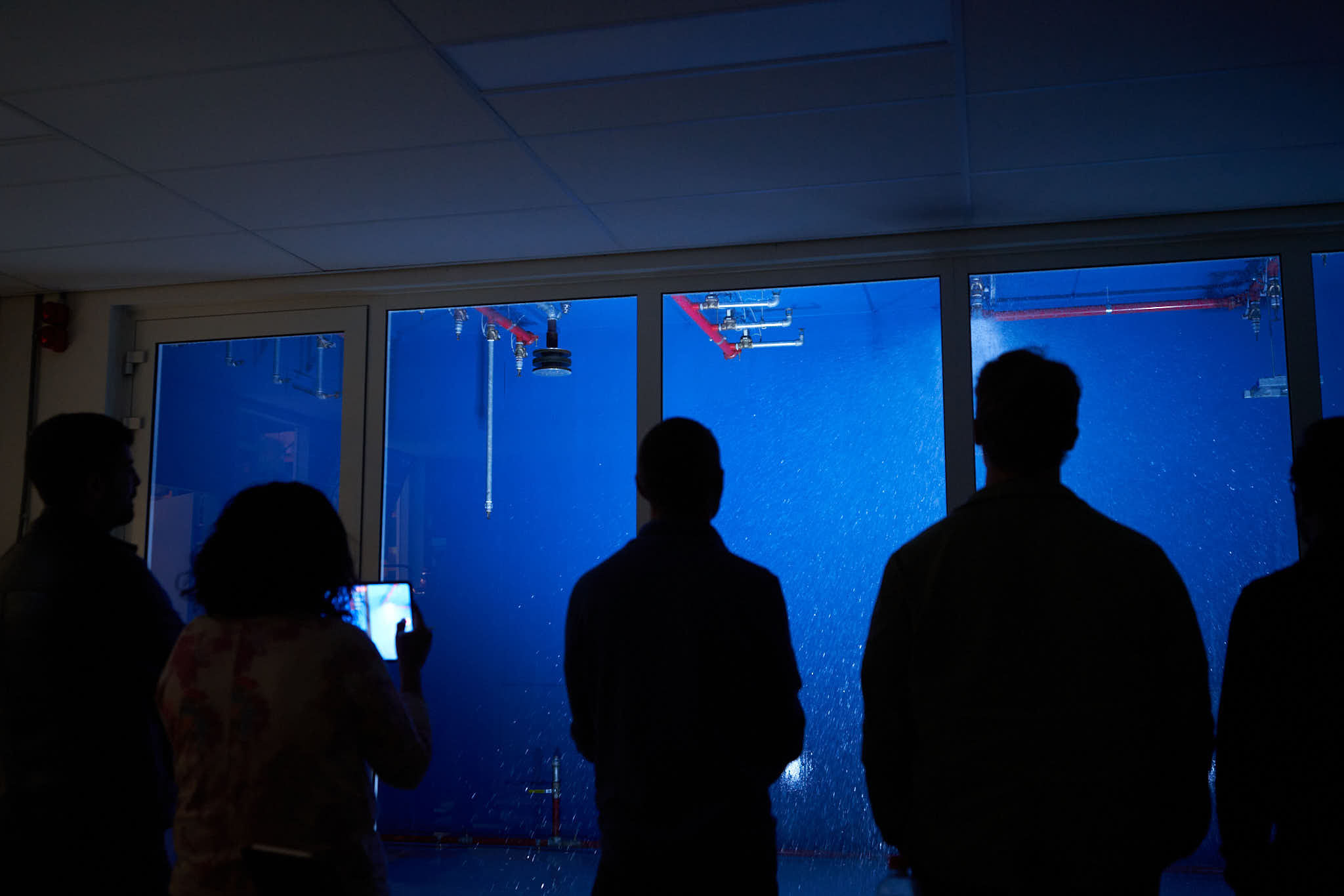
Along with hands-on training, the TechXchange facility includes a special room with working sprinkler systems.
Sprinklers and special challenges
And, as part of the course, risk engineers can work with a discharge demo room for sprinklers, including water mist and gas extinguishing systems. Elsewhere at the center, a special hazards room provides mock-ups of industrial scenarios with unique fire risks, such as heavy machinery vehicle systems and commercial cooking equipment, complete with kitchen hood and a fully operational extinguishing system. In training, they will activate and operate the system to understand the exact sequence, which includes nozzles discharging compressed gas.
If they make it this far, participants in the courses will be challenged to spot common issues and faults set by the experts in a final exam. Do you think you could be a risk engineer? Ready for a little test? Remember the questions at the beginning of this article? Here are the answers:
Answers to the questions at the beginning of this article:
- If your giant donut fryer catches fire, insurers including Zurich advise using a ‘proven and listed local application’ water mist extinguishing system, ideally within a sprinkler-protected building.
- People’s growing appetite for frozen food has led to a significant increase in industrial freezer warehouses. Water in a sprinkler system inside a freezer would freeze. To deal with such fires, a dry or pre-action sprinkler system is common, where water is only introduced after a fire is detected. Alternatively, an oxygen reduction system using nitrogen could be acceptable, but presents challenges with human access and maintaining concentration in a warehouse-sized compartment.
- What about the need to replace an oil filter on a diesel pump? These should be changed every year, or two at the maximum. If a risk engineer notices that the filter has been painted to match the pump, they should be suspicious – it can mean that the engine oil filter has been in use for many years. When built, pumps are painted in the factory with oil filters installed. New filters are not painted red like the pumps. So if the filter is painted red, this may indicate it has been repainted, suggesting poor maintenance, and raising concern about necessary weekly testing recorded on an hours-run meter.
Among his many roles, Stuart Lloyd, Zurich Resilience Solutions’ Global Practice Leader for Fire Protection, is actively involved in fire protection standards and research globally. He is the current chair of the Property Insurers Research Group within the National Fire Protection Association (NFPA) in the U.S. He represents Zurich on sprinkler committees for the NFPA (U.S.) and UK British Standards Institute (BSI). Additionally, he has been selected by his national standards body (BSI) to represent the UK for many different fire protection medium types (water, gas, chemical, and foam) at the global International Organization for Standardization (ISO) and European Committee for Standardization (CEN). He also serves on the European Fire Sprinkler Network, and British Automatic Fire Sprinkler Association technical committees.
Photographs by George Brooks
Unrivalled expertise in fixed fire protection
Find out how you can protect your business from the impacts of fire damage, with the support of our expert team of fixed fire protection risk engineers.